







































Guest post by Søren Kamper
There was a time when Star Wars was not permanent weather.
That is hard to explain now, because Star Wars has become less like a film series and more like a utility. It is always there. Streaming, publishing, merchandising, spinning off, explaining itself, then explaining why the explanation mattered.
But Generation X remembers something stranger.
We remember a world where Star Wars arrived like a meteor strike. There was before Star Wars, then after Star Wars, and after that everything looked different. Toys changed. Lunchboxes changed. Bedroom walls changed. The sound a plastic spaceship made in a child’s hand changed.
The story of George Lucas creating Star Wars has been retold so often that it has almost become its own mythology, which is why something like Lucas Wars still hits an interesting nerve. Star Wars was not born as an obvious empire. It was a strange, difficult thing that somehow escaped into the world and rewired the culture.
Then, for a while, Star Wars was not constant. It lived in memory, toys, paperbacks, comics, VHS tapes, playground arguments and Kenner figures with missing weapons.
And eventually, it lived in games.
Because Star Wars games did something the movies could not. They did not just show the galaxy. They gave us a way to occupy it.
The Coin-Operated Galaxy

For many players, the first true act of living inside Star Wars was not cinematic. It was mechanical.
A cabinet. A vector screen. A flight yoke. A trench. A coin disappearing into a machine.
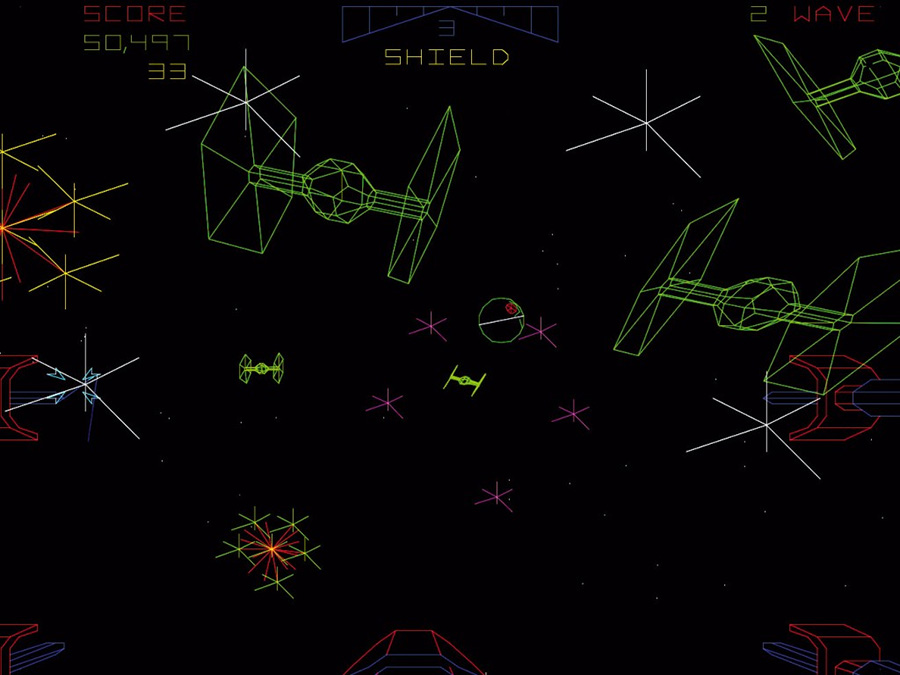
Atari’s 1983 Star Wars arcade game remains one of the purest translations of the original film into play. It did not need every detail. It understood the essential fantasy: sit in the cockpit, trust the Force, don’t hit the walls, blow the thing up before the machine eats another quarter.
The films made the Death Star trench run mythic. The arcade game made it personal. Suddenly the trench was hostile geometry. TIE fighters were targets. Vader was not just a breathing problem in black plastic. He was a threat vector.
Your hands mattered.
Star Wars stopped being only something to watch and became something to perform. For Gen X, raised between analog and digital, between the toy aisle and the arcade, that distinction mattered. The games were not replacements for the films. They were extensions of the daydream.
Before Star Wars became a streaming category, it was physical: toys, VHS tapes, posters, paperbacks, action figures and lunchboxes dented by time. That is why a book like Star Wars: 100 Objects feels close to the emotional truth of the franchise. Objects are how a fictional galaxy becomes real enough to live with.
Games belonged in that same world. A cartridge was an object. A joystick was an object. A PC big box was an object. You could put Star Wars in the machine. Then the machine asked what kind of fan you were.
The PC Years Made Star Wars Serious

The early home versions had charm, but the PC games gave Star Wars a second spine.
X-Wing and TIE Fighter were not content to be arcade fantasies. They wanted commitment. They wanted manuals. They wanted key commands. Space combat was not just swooping past a camera while John Williams did the emotional heavy lifting.
You had to manage shields. Balance lasers. Identify targets. Follow mission objectives, which was rude, frankly, because many of us were emotionally committed to flying in circles and pretending we knew what we were doing.
X-Wing made the Rebel pilot fantasy feel earned. TIE Fighter did something stranger and more daring. It let players inhabit the Imperial machine. Not as Vader. Not as the Emperor. As a pilot. A skilled cog. A professional problem in a very questionable uniform.
The films gave us icons. The PC sims gave us procedure. They made Star Wars feel like a place with training, bureaucracy, mission briefings, systems and consequences.
For a lot of Gen X players, that was the better dream.
The Galaxy Between the Movies

Not every Star Wars game needed to be grand. Some of the most important ones worked because they filled the spaces between the films.
Star Wars: Rebel Assault is one of those strange CD-ROM fossils from the moment games were trying to become cinema by sheer force of storage capacity. It is stiff, narrow, compressed and occasionally hostile to the human desire for control. It is also fascinating.
Dark Forces did something quieter and more important. It made Star Wars feel like it existed between the movies.
Kyle Katarn was not Luke. He was not Han. He was not a chosen one with destiny dripping off his boots. He was a mercenary with a blaster, a mission and the misfortune of spending too much time inside Imperial facilities designed by architects who clearly hated railings.
Dark Forces gave us corridors, detention centers, weapons labs, elevators, switches, sewer systems and the Dark Trooper project. It turned Star Wars into spaces. Places where the Empire felt less like a symbol and more like an employer with terrible safety standards.
Then Jedi Knight pushed Kyle toward the Force, but the important thing was that he did not begin there. His Jedi story felt messier because it came from another genre first. Shooter before myth. Mercenary before knight.
That was one of the great gifts of the older Expanded Universe era. It allowed games, comics, novels and tabletop books to build corners of the galaxy that did not need to be the center of everything.
There is a reason a piece like “You Don’t Have To Be a Star Wars Fan To Love Andor” feels connected to this older tradition. The best Star Wars often happens when the galaxy stops posing for the poster and starts looking lived in.
The N64 Made Star Wars Physical Again

If the PC era made Star Wars serious, the Nintendo 64 made it wonderfully lumpy and physical.
Shadows of the Empire is the perfect example. Snowspeeder battle. Third-person shooter. Jetpack adventure. Speeder bike chase. Boss fights. Dash Rendar’s shoulder pads, which remain one of the Expanded Universe’s most aggressive architectural decisions.
It should not work as well as it does. In places, it does not work at all. But that is part of the charm.
Shadows of the Empire feels like Star Wars wrestling with early 3D technology in public. The camera is suspicious. The aiming is a negotiation. The platforming occasionally feels like a dare.
Rogue Squadron sharpened the vehicle fantasy. Episode I: Racer found the best game inside The Phantom Menace and wisely ignored the Galactic Senate.
These were not games about explaining Star Wars. They were games about doing one Star Wars thing with enough force that it stuck in muscle memory.
Wrap the tow cable. Hit the boost. Don’t crash. Try again.
That was the living-room loop, and it worked.
The Galaxy Became a Place

Games were not the only way fans learned to live inside Star Wars. That same impulse runs through the history and culture of Star Wars fan films: the galaxy invited participation. Star Wars became something people did, not only something they consumed.
By the time Knights of The Old Republic and Star Wars Galaxies arrived, that idea had evolved.
Star Wars games no longer had to give us isolated fantasies. They could give us identities.
Knights of the Old Republic let players step into myth and decide what kind of myth they wanted to be. It was choice, party members, planets, morality, betrayal and the intoxicating idea that Star Wars history extended far beyond the films.
Star Wars Galaxies went even further by making fame optional. You could be a musician, crafter, doctor, scout, creature handler, merchant, cantina weirdo, or some poor soul trying to make a living in a universe where every few years someone builds another planet-killing device.
That is living inside the galaxy.
Not visiting it. Not reenacting it. Living in it.
For a generation that watched Star Wars move from cultural earthquake to VHS box set to Expanded Universe shelf to digital world, that shift meant something. The galaxy had become inhabitable.
We Played the Space Between

The obvious classics deserve their reputations: X-Wing, TIE Fighter, Dark Forces, Jedi Knight, Knights of the Old Republic, Battlefront and Republic Commando.
But the larger story is stranger and better: arcade cabinets, DOS boxes, SNES cartridges, CD-ROM drives, N64 rentals, PC big boxes, MMOs, cancelled projects, remasters, fan patches and mods.
That is why an archive like All Star Wars games ever made is useful. Not because history should become a checklist, but because the checklist reveals the size of the obsession.
Star Wars games are not just licensed products. They are memory machines. They hold the awkward stages of both a franchise and a generation trying to figure out what it meant to carry a galaxy forward after the credits rolled.
Gen X did not just watch Star Wars become forever. It played that transformation one machine at a time: a coin slot, a cartridge, a joystick, a keyboard, a CD-ROM, a save file, a server.
Each one taught us that Star Wars was not only a story about farm boys, princesses, scoundrels, Sith Lords and doomed space stations.
It was a place.
A strange, messy, expandable place.
And once games taught us how to live inside it, we never really left.
About The Author
Søren Kamper runs Star Wars: Gaming, a long-running Star Wars gaming site covering classic LucasArts titles, SWTOR, KOTOR, modern Star Wars games, mods, retro releases, and the strange corners of Star Wars gaming history that never really disappear.