

































For ten years now, the Duffer Brothers’ Stranger Things has pulled in pretty much everybody, wrapping its story in an 80s glow and stacking the table with conspiracy chatter, paranormal weirdness, and ominous government labs that always seem to sit just off the edge of town. The fifth and last season closed the book on New Year’s Eve 2025, and in the process, it turned a bunch of then-unknown kids into household names. The plot has an ending, sure, but the franchise hardly packed up and left. It keeps circulating through transmedia offshoots, an animated prequel on the way, a stage play, novels, comics, branded odds and ends, toys, and now, at long last, the full run collected on Blu-ray and 4K UHD.
And if you’re someone who never really jumped in, watching it now in 4K is a useful reminder of what the series does beyond nodding at the stuff I grew up on. Yes, it’s openly a love letter to the movies, TV, and books that fed my imagination. Still, it also works as a gateway drug for younger viewers, steering them toward storytellers and filmmakers they might never otherwise stumble across.
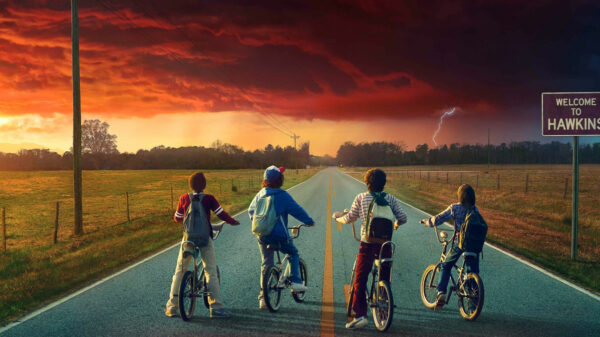
Back in 2016, the pitch seemed simple enough: a quiet Indiana town, kids on bikes, a shadow in the woods, and that familiar hum of retro longing. Then the first season ended and it was obvious the show had outgrown the “cute nostalgia” box. It became a bigger, more confident blend of 80s pop culture DNA, horror tension, and real emotional weight. What could’ve been a flimsy retro stunt turned into something more sincere, friendship under pressure, trauma that lingers, and the slow, uncomfortable process of watching childhood slip away.
The Duffers don’t act like they invented any of this from scratch, and that honesty is part of the charm. Their influences are right on the surface. You can feel Spielberg’s wide-eyed suburbia, Carpenter’s chill, King’s small-town dread, Lucas’s adventure pulse, Cronenberg’s body horror unease. One moment echoes E.T., another carries the kid-bond energy of Stand by Me, then you’re in The Thing territory, or body-snatcher paranoia, all stitched together with classic Amblin coming-of-age momentum. The references usually land the right way, recognizable without turning into cosplay, and they’re there to support the story, not substitute for it.
Hawkins, Indiana looks like a postcard until Will Byers disappears. That’s the old-school hook, and the show keeps widening the circle from there, secret facilities, psychic kids, parallel worlds, ancient monsters, and eventually a fight that’s basically about reality holding together. Still, even when the spectacle ramps up, the stakes stay intimate. Saving the world matters because it means saving someone you love.
The mythology’s anchor is the Upside Down, a poisonous, soot-dusted twin of Hawkins, all drifting spores, creeping vines, and things that shouldn’t move the way they do. It isn’t treated like a simple “other dimension” so much as a link to something deeper and more chaotic, sometimes framed as the Abyss or Dimension X. The show pins its origin to November 6, 1983, when Eleven, pushed by Dr. Brenner, psychically connects with a Demogorgon and tears open a doorway, leaving a copy of Hawkins trapped in place like a bad memory you can’t shake.
On the human side, the big engine is Hawkins National Laboratory, a cover for experiments that reach into psychic ability and interdimensional research. Pulling from conspiracy lore, the Montauk vibe, Cold War-era parapsychology programs, the series paints a CIA-backed operation that studies powered children, the “Numbers,” with Eleven and Henry Creel among them, while trying to turn what they find into a weapon. Those choices are what open the door for the monsters, and the early seasons thrive on the slow, piecemeal uncovering of the truth by kids and adults who refuse to stop digging.
Brenner, played with icy control by Matthew Modine, is the lab’s architect, and the show never softens what he is. He took Eleven from her mother, he broke children in the name of research, and to Eleven he’s “Papa,” a title that reads as love only on the surface, underneath it’s ownership and abuse. Later, Dr. Sam Owens, played by Paul Reiser, slides into the role with a friendlier manner, but he’s still operating inside the same machine. Owens tries to contain the fallout, tries to shield people like Will and Eleven, yet he can’t fully escape the system that made the disaster possible.
As the story grows, the monster ladder fills in. Season 1’s Demogorgon is a lethal predator, named by the kids after a Dungeons & Dragons demon prince, and it feels like the thing at the center of the nightmare. Later you learn it’s closer to muscle than mastermind. The Mind Flayer arrives as something larger, an immense shadow presence tied to the Abyss, working through a hive-mind impulse that wants to absorb people and erase what makes them themselves.
Then comes Vecna, the face that turns the mythology into something cruelly personal. He starts as Henry Creel, a gifted, damaged boy who kills his family, ends up in Brenner’s care, and is finally thrown into the Upside Down by Eleven. There he binds himself to the Mind Flayer, shaping its form and operating as its “five-star general,” even as the Mind Flayer remains the bigger intelligence behind the curtain. By season 4, Vecna steps forward as the main threat, stalking teenagers through their guilt and grief, making the supernatural feel like a psychological trap as much as a monster movie.
That climb, from one creature in the trees to a full interdimensional war, tracks the characters growing up. Over time, the external horror starts to rhyme with internal damage. Even the Upside Down, a frozen image of what Hawkins used to be, functions like a built-in metaphor for nostalgia itself, a place where time refuses to move on and every old wound stays open.
Will Byers, played by Noah Schnapp, is the quiet center. His vanishing kicks the whole story into motion, and even when he’s missing or possessed or pushed to the side, his arc keeps pointing back to what trauma does, how it changes a kid, and how “surviving” doesn’t mean the experience is gone.
Eleven, played by Millie Bobby Brown, enters as a frightened, nearly mute lab runaway and gradually learns how to be a person, how to speak, how to trust, how to belong. Brown’s performance is physical in the best way, a look, a stance, a flinch can carry a scene. The strongest part of Eleven isn’t the telekinesis, it’s her decision to choose compassion after being raised like a weapon. In the mythos, she opens the door to the Upside Down and becomes central to closing it later. Also, she loves Eggos.
Mike Wheeler, played by Finn Wolfhard, works as the group’s moral anchor, loyal even as adolescence starts to tug him in messier directions. His relationship with Eleven is the show’s emotional spine, a first-love story that’s also a lesson in what love demands when you’re scared and still figuring yourself out.
Dustin Henderson, played by Gaten Matarazzo, is the social glue, funny without being empty comic relief, and oddly perceptive about people. Lucas Sinclair, played by Caleb McLaughlin, brings skepticism and grounded thinking, while also getting pulled between fitting in and staying loyal. Max Mayfield, played by Sadie Sink, arrives in season 2 as the sarcastic new kid and ends up one of the show’s most fully drawn characters, her grief and depression building toward a standout episode that makes her an obvious target for Vecna. Billy, her stepbrother, played by Dacre Montgomery, begins as a dangerous bully, then becomes a tragedy when the Mind Flayer exploits his damage, ending with a final act of protection. Erica Sinclair, played by Priah Ferguson, starts as the sharp little sister and quickly turns into a real part of the core group, blunt, capable, and hard to underestimate.
With the adults, Joyce Byers, played by Winona Ryder, is the unbreakable parental force, the person who refuses to accept the easy explanation when she knows her kid is out there. Jim Hopper, played by David Harbour, shifts from a haunted small-town cop into a reluctant hero, building a family by protecting Eleven. Bob Newby, played by Sean Astin, offers warmth and decency, and his death is the show’s reminder that innocence doesn’t buy safety. Murray Bauman, played by Brett Gelman, starts as a paranoid conspiracy guy and turns into an unexpectedly useful ally as the truth gets uglier.
Nancy Wheeler and Jonathan Byers grow into investigators, bonded as much by shared trauma as by affection. Steve Harrington gives the series one of its best turnarounds, from smug popular kid to genuinely selfless protector, while keeping his humor and heart intact. Robin Buckley arrives as Steve’s coworker and becomes essential, and her coming-out moment lands because it’s treated with honesty instead of being pumped up for drama.
The show shifts its tone each season without losing its core. Season 1 is tight mystery-horror with the Demogorgon and the lab’s secrets. Season 2 leans harder into the mythology and the lasting marks trauma leaves behind, bringing in the Mind Flayer. Season 3 swings outward into mall culture, Cold War paranoia, and bigger, louder action, while adding Russian efforts to exploit the Upside Down. Season 4 goes gothic with Vecna, reframing what came before and looping the monster chain back to Henry Creel and Brenner’s work.
The music isn’t just background flavor, it pushes the story. Kate Bush’s “Running Up That Hill” becomes tied to Max’s fight for her life, and Metallica fuels Eddie’s stand. Visually, the series gets bolder with each chapter, stepping from small-town dread into something closer to a film-scale spectacle, while keeping a tactile feel and a fondness for practical texture. That contrast, cozy Americana on one side, grotesque nightmare underneath, stays one of the show’s most effective tricks.
Under all the mythology, Stranger Things is a story about time. You can’t preserve childhood in amber. Friends drift, families change shape, first love gets complicated, and parents eventually learn they can’t shield their kids from everything. Kids, in turn, realize adults are just as frightened and unsure as they are. Each season marks another step away from innocence. The Upside Down isn’t only a scary place, it’s a snapshot of the past that won’t thaw, which makes it a near-perfect stand-in for nostalgia. To survive, the characters have to accept change instead of trying to crawl back into what used to be.
People often frame the show as Gen X bait, stuffed with references for anyone who lived through the 1980s. Yet it also caught a massive Gen Z audience. Watching the young cast age on screen creates its own shared coming-of-age effect, you’re not just following characters, you’re seeing the actors grow up in real time.
The themes are broad enough to hit even if you’ve never watched E.T. or read Stephen King. Friendship, outsider loneliness, family friction, first love, grief, those don’t require a reference guide. The horror-thriller blend is scary enough to keep the pulse up, and the character work is strong enough to make the danger matter.
For younger viewers, the 80s backdrop plays more like retro escape than personal nostalgia, a world without smartphones, where kids vanish into the neighborhood for hours and mixtapes are currency. Then word of mouth and social media did what they do, and once the show became a cultural marker, its reach only widened.
So the audience ends up genuinely mixed. Older viewers get that Spielberg-and-King-flavored love letter. Younger viewers get a sharp, character-led supernatural thriller with a stylized retro sheen that still feels new. That overlap is a big part of the phenomenon, it speaks across generations without talking down to either side.
When you strip it all back, Stranger Things isn’t mainly about monsters crawling out of another dimension. It’s about ordinary people choosing each other when everything falls apart. It insists that friendship can outmuscle fear, that family is something you build as much as something you inherit, and that love, romantic, parental, platonic, is the thing that can push against the dark.
It starts with a kid vanishing into the unknown. It ends with the simplest answer the series has always believed in: you don’t get through the unknown alone. Not many shows have mixed blockbuster momentum with real feeling this cleanly, and even fewer have left such a clear imprint on pop culture. Stranger Things is drenched in nostalgia, but the mark it made belongs to right now.

As for the 4K UHD deluxe edition, it’s the kind of set built to show off, reference-level picture and sound, plus a nicely designed box with new wrap-around artwork. The extras run deep: cast and crew interviews, behind-the-scenes featurettes, set tours, bloopers, and a pile of physical ephemera, an arcade token, a Hellfire Club patch, Hellfire Club d20 dice, 25 art cards, five double-sided posters, reversible sleeves with brand-new artwork, a double-sided fold-out map of Hawkins, and a 148-page perfect-bound art book that’s genuinely beautiful.
Highest recommendation.