
























































Pretty Maids All in a Row was written and produced by Gene Roddenberry. It was his first completed project after Star Trek and his only big-screen writing credit. If you’re going to talk about this movie, you can’t not talk about that.
There’s a simple reason why The Great Bird of the Galaxy took on a soft-core black comedy about a guidance counselor who seduces high school girls and murders the ones who threaten to tell. It’s not a problem they have in the 23rd Century, but one that Roddenberry was definitely facing in 1971.
The cancellation of Star Trek had left Roddenberry in a Tholian Web of money problems. He was the “space guy” who’d tanked an expensive show after three seasons, and thanks to his affair with cast member Majel Barrett he was paying heavy alimony to his ex-wife. Then Herb Solow, the former Desilu executive who’d greenlit Star Trek, came to his rescue: how’d he like to make a nudie?
This explains the need but not the deeper mystery. How did the same man who showed us a future based on individual dignity, where superior alien civilizations are forever admiring our ability to conquer our baser instincts, manage to sit down at his Smith-Corona and pound out a scene where a high school kid gets horny looking at a dead cheerleader’s ass?
It’s tempting to blame Roger Vadim. The director of And God Created Woman and Barbarella already had a reputation for frothy sex romps—so much so that Playboy ran a pictorial of the unclad female cast called “Vadim’s ‘Pretty Maids.’” But Vadim was a hired hand. This was Gene’s baby.
And it’s a genetic match. The pretty maids’ miniskirts were crafted by Star Trek’s William Ware Theiss, designer of the alien babe costumes that launched a thousand cosplays. James Doohan—also no doubt hungry for work after NBC shut down Scotty’s warp engines—plays a state police detective. William Campbell, who’d guested as omnipotent space brat Trelane and the Klingon captain Koloth, has a bit part as a yokelish deputy. Roddenberry was nothing if not loyal.
But there’s no Dorothy C. Fontana or Gene L. Coon on Pretty Maids All in a Row, no cooler heads with an eye for deeper themes or character-driven drama to rein in Roddenberry’s id or curb his wilder ideas.
And so it may well be that what we’re seeing is who Gene Roddenberry is after you strip away the high-mindedness and blinking bridge lights: a dirty old man.
The movie’s opening scene—a sexually thwarted teen named Ponce (John David Carson) rides his uncool Vespa around Santa Monica, scoping out hot girls who won’t give him time of day—maps out the movie’s sexual politics.
As the Osmonds (the Osmonds?) warble out the theme song, it becomes clear how we’re meant to view females in this movie. They’re sexy and braless and they have all the power. They are also vapid and galactically dumb.
I’m not going to press the analogies harder than they want to go, but this was exactly the setup in the Star Trek episode “Spock’s Brain.” All that’s missing are those little wrist consoles the foxy, airheaded alien women used to make Kirk and McCoy writhe in pain and, well, Spock’s brain.
As in that episode, it takes an alpha male to establish order in Pretty Maids. The rooster in this particular henhouse is “Tiger” McDrew, who is the local high school’s assistant principal and guidance counselor and football coach (I guess the extra pay is how a public school employee pays for a beachfront home and a sports car).
He’s got a big office with a nice soft couch and a door he can lock whenever one of the school’s many available females needs a little “extra” counseling.
So-very-hetero Tiger is being played by so-very-not Rock Hudson, a meta-irony we can appreciate today. But in 1971, Hudson was still the archetypal cocksman, playing the ladykiller with a pornstache and a swashbuckler grin. He can fuck anybody and nobody fucks with him. He’s nominally second in command, but the principal is played by a quavering Roddy McDowell, so no competition there.
When Ponce discovers the aforementioned dead cheerleader in a bathroom stall—a note pinned to her panties reading “SO LONG, HONEY”—it kicks off an investigation that draws in a clueless cop (Keenan Wynn) and a suave state police detective played by the very suave Telly Savalas, Kojak without his lollipop.
How we’re meant to feel about this girl’s murder is decided quickly: we’re not. All we learn about her is that she got terrible grades and looked fantastic in her cheerleader outfit (it’s the principal saying this). We never see her face because it’s plunged into a toilet, a pointed metaphor for her complete disposability. Her name was Jill, by the way.
Where the bodies are found is not coincidental. The boys’ bathroom, the boiler room, the football field. All male domains.
Tiger takes his alpha male responsibilities seriously. As football coach, he is as much a mentor to the boys as a “counselor” to the girls. During a halftime locker room speech, he leads the football team in chants of “Kill! Kill!” When a Black teenager is suspected of the crimes, Tiger defends him even at the risk of exposing himself. He may be a predator but he’s no racist.
But his biggest protégé is Ponce. He sees great potential in his young ward and a major obstacle: the boy needs sexual confidence. Translation: he needs an older woman to show him the ropes.
Vadim originally offered the hot-for-teacher role of Miss Smith to Brigitte Bardot. I guess he reasoned that if you’re going to show an older woman seducing a high school boy, it helps to layer on a little European sophistication.
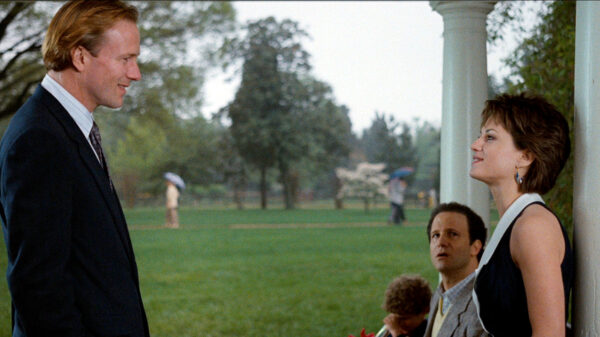
But Angie Dickinson booked the part, probably wondering how she went from Rio Bravo to this. She plays Ponce’s cherry-popper with more awkwardness than steam. When they slow-dance, she has to remind the boy that he’s supposed to lead. Eventually, Ponce gets it into his head that he’s meant to be in control here.
Was this what Gene Roddenberry was going for? Is sexual charisma how you rule the galaxy? Was Tiger McDrew the dark mirror of Captain Kirk?
Roddenberry insisted that he was satirizing guys like Tiger. He blamed Roger Vadim for turning his black comedy into a sex farce. If Gene Roddenberry had gotten his way—according to Gene Roddenberry—then Pretty Maids All in a Row would have exposed the real villains of the story, a society that sweeps the sins of powerful men under the rug. He claims to have been horrified when Vadim (not exactly the world’s biggest feminist) delivered a movie that makes Tiger a charming antihero and declares Ponce the winner because he’s learned how to pick up girls.
But that is in fact the script Roddenberry wrote.
There’s no moment where Tiger is exposed for the sagging, jaded predator that he is. We’re meant to enjoy watching him outwit the cops. His victims bring on their own doom by insisting that he tell his wife, or sleep with them exclusively, or just have sex when it isn’t on his terms.
They’re not individual people: the credits list most of them in a block as the “pretty maids,” like Dean Martin’s Golddiggers.
This is why I think Gene Roddenberry disavowed Pretty Maids All in a Row. Not because it was awful, but because its awfulness was too revealing. It surfaced attitudes about women that Star Trek suppressed imperfectly: episodes like “Mudd’s Women,” “Elaan of Troyius,” and “A Private Little War” all revolve around alien females that supposedly no man can resist. Kirk doesn’t, and then he does.
Worse, the movie reveals the kind of writer Roddenberry was with no crack team behind him (he seems eager to flash a little sophistication by having Dickinson sexily recite a passage from Paradise Lost, which is not a very sexy poem).
Most damning of all, it revealed what he would do for money. Which is only a problem if you’re supposed to be above that sort of thing.
The decade following Pretty Maids All in a Row would see Gene Roddenberry clawing his way back to the only real success he’d ever enjoyed. His movie-length pilot for Genesis II failed to land a series. He spent years after that in the wasteland of fan conventions, which finally gave him the credibility to pitch Star Trek: Phase II. It didn’t happen, but he did get Star Trek: The Motion Picture, which led to Wrath of Khan, which led to The Next Generation, all of which sealed his reputation as a visionary for a better tomorrow.
But Pretty Maids All in a Row did happen, a satire that satirizes nothing. For a comedy, there’s not a lot of laughs. For a movie with so many naked young women, it’s not much of a turn-on.
What we have is a relic from a time when “sexual liberation” was filtered through a Playboy After Dark lens (besides the Roger Vadim piece, the movie also made the magazine’s annual “Sex in Cinema” review). This kind of free love demanded that younger women willingly surrender to older men who were free to move on at any time with no strings attached. The power dynamic of teachers sleeping with students is treated with a wink. The girls’ deaths are punchlines.
It’s not pretty, but the movie is part of Gene Roddenberry’s legacy. Oddly enough, it’s also proof that the future he predicted actually is a little more enlightened. We’re not perfect, but we’ve evolved at least to where this kind of subject matter isn’t automatically considered saucy or provocative, just louche and kind of dismal.
Ironically, it was Star Trek that helped us get there. And it only took a few decades.
To purchase this title click HERE.
This release is one of the thousands of titles available from Movie Zyng, official licensed home of The Warner Archive Collection. A small fraction of each purchase helps support this website.