












































Paramount Pictures
Reacher returns to form in its third season.
The first season, based on the novel Killing Floor, was a perfect introduction because it gave Reacher a likeable ensemble of normal people to work with, and let us learn about him through their eyes slowly.
Season 2, based on Bad Luck and Trouble, gave us too much of a good thing. Reuniting Reacher with his old investigative team was logical, but the number of relationships, flashbacks, shared memories, and competing personalities weakened the central plot.
Instead of an outsider entering an unfamiliar community, Reacher became the leader of a squad.
Jack Reacher is most compelling as a character when he enters a pressure cooker, takes his time, identifies the bad guys, and slowly begins turning up the heat.
Season 3, based on Persuader, is back to basics.
Jack Reacher (Alan Ritchson) is in sleepy Abbotsville, Maine when he witnesses an attempted abduction of a college student, Richard Beck (Johnny Berchtold). Reacher intervenes, but in rescuing Richard he inadvertently dispatches a plainclothes cop and the student’s powerful father, Zachary Beck (Anthony Michael Hall), offers Reacher a job, apparently giving the wandering former military investigator another opportunity to enter a dangerous situation.
The opening episodes then reveal a clever reversal. Reacher was not accidentally standing in the right place at the right time. The kidnapping was staged as part of a DEA operation led by Susan Duffy (Sonya Cassidy), with agents Villanueva (Roberto Montesinos) and Eliot (Daniel David Stewart) helping Reacher manufacture the rescue. His real mission is to infiltrate Beck’s organization and locate a missing undercover informant before her cover is exposed.
Once inside Beck’s compound, Reacher must determine who controls the criminal operation, what is being moved through Beck’s legitimate business, and why everyone in the house seems possessed by an unnamable dread.
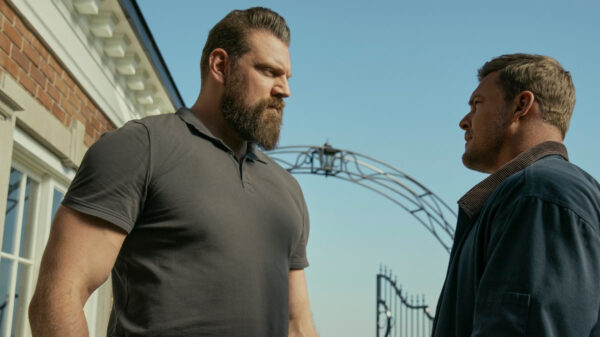
His investigation places him between Beck, the guarded Richard, and Paulie (Olivier Richters), an enormous enforcer who is so big he gives us actual cause to be afraid for Reacher. The case also reconnects Reacher with Francis Xavier Quinn (Brian Tee), a figure from his military past whom he believed he had already killed.
Season 3 represents a more focused approach to the character than anything that’s come before.
Reacher has allies, but the story belongs to him. Most of his work happens inside the belly of the beast which gives even routine genre scenes tremendous suspense. The undercover structure also forces him to do more than punch people: this is Reacher at his cagiest, working plans within plans and always in more control than he lets on.
Alan Ritchson remains convincing during the fights, but I find consistent joy in how his Reacher always has something going on behind his eyes, and is willing to take his bluffs and double bluffs right up to the limit. He’s constantly measuring everyone around him for weak spots. It’s a great central performance, full of confidence.
This confidence extends to the season’s scripting.
I cannot count how many prestige action shows I’ve reviewed for this site where I complained that this was a two-hour movie stretched to eight hours. They begin with a strong premise, spend several episodes withholding obvious information, and finally return to the climax that would have arrived an hour earlier in a feature film.
Not here. This is an honest-to-goodness hard boiled mystery novel.
A novel already contains turns, conversations, secondary objectives, changes in location, and discoveries designed to sustain a longer narrative. The series therefore has a command of story, characterization and dialogue delivered on the run that is unique among its contemporaries. Scenes do not exist solely to fill the distance between action sequences. You actually have to pay attention.
I can’t tell you how refreshing that is.
Anthony Michael Hall is excellent as Zachary Beck.
Hall avoids playing him as a conventional criminal mastermind. Beck is nervous in ways that make the plot more unpredictable and it feels refreshing. He’s never entirely secure in his position. Beck wants to treat Reacher as hired muscle, yet he cannot stop wondering whether he has invited a predator into his home. You’re listening to dialogue for hidden meanings, you know that every plot beat is a test and you never know who is really in control to see who is testing whom.
Story. Character. Theme. They’re not just all present, but as in the best crime thrillers they all work together to support one another.
The action remains satisfyingly blunt.
Reacher does not fight like he’s trying to entertain an audience. He fights like someone trying to end a problem as quickly as possible. Paulie’s presence is a particularly smart choice because physical superiority is normally Reacher’s most reliable advantage. Watching him assess someone even larger creates suspense before either man throws a meaningful punch. It’s a bit like how you know Sean Connery is tough as hell as James Bond so the process of building Harold Sakata up as Oddjob, a guy who intimidates even Bond, makes their final fight so much satisfying.
Most importantly, Season 3 remembers that the strength of Reacher comes from clarity of purpose.
Reacher is a precise observer and speaker and acts decisively. The world around him may be corrupt and complicated, but his response is not. By returning to a contained mystery, limiting the supporting cast, and placing its hero undercover, the series regains its balance.
Bring on Season 4.
Recommended.