




























 Written by Phillip Szostak
Foreword by Tony Gilroy
Afterword by Dan Gilroy
Published by Abrams Books
Saying it right out of the gate: I didn’t read The Art of Star Wars: Andor.
I absorbed it. This Art of Star Wars edition is every bit a masterclass in the stunning visual storytelling of the Andor television series, streaming on Disney+, as it is a celebration of the extraordinary artists that gave the series it’s authentic real-world look.
I loved reading, sorry; absorbing it and studying the art just as much as I enjoyed the series.
This is Szostak’s seventh entry into the Art of Star Wars series (his eighth, The Art of Star Wars: The Mandalorian and Grogu is on the way.) This time around, we’re treated to a production diary of sorts alongside the art and commentary from many of the visual creative team leads, including Production Designer Luke Hull, Prop Masters Martyn Doust and Ben Wilkinson, Set Decorator Rebecca Alleway, Costume Designer Michael Wilkinson, and excerpts from showrunner Tony Gilroy’s “design manifesto.”
My production nerd brain especially appreciated the inclusion of dates and/or (no pun intended) production weeks of certain locations and scenes. In some cases, we even get call and wrap times (workday start and finish times). Learning which parts of sets were re-used or redressed helped me appreciate the filmmaker’s craftiness when considering scheduling and budget constraints such as Ghor’s street facades repurposed for Mon Mothma’s estate entrance.
The common thread in The Art of Star Wars: Andor, in spite of the challenges of COVID-19 and the SAG/AFTRA and Writers strikes which affected both seasons 1 and 2 respectively, was that everyone involved was emboldened by Tony Guilroy’s gregarious leadership. Gilroy encouraged everyone to bring their best to the table to convey a relatable real-world look to Andor not seen since the original Star Wars film released in 1977. The Art of Star Wars: Andor gives a true sense that the Andor television series was created by a village, rather than by a king.
Szostak takes us from the inception of Andor through its handoff to Rogue One: A Star Wars Story, which, technically, is where it all began.
Tony Gilroy’s aforementioned design manifesto tells us how the design team was assembled and reinforces his mandate for grounding every visual in the real world. Every detail had to be thought out under this mandate. Every planet, every culture had to have a unique look and feel, right down to its written language and currency. The supporting visuals included in The Art of Star Wars: Andor expose us to the depths of detail audiences would never consciously notice. Collectively, however, these details tell a story about people.
Every time Szostak takes us to a new (and previously visited) Star Wars world in Andor, we learn and see every thought that went into creating that place and culture. Every world a character in its own right, just as fleshed out as any human performer. It’s truly impressive and makes me feel envious of the team who got to bring those worlds to life.
Cassian Andor’s home planet of Ferrix conveys a working-class sense of community and tradition reflected in sensible, pocket-filled overalls, task-specific equipment, and an expansive practical set that looked as if every brick was laid by hand by its people. Every shop created had its own specialty, whether it was selling specific ship parts or specific food items like cheese or fish. In Bix’s case, Cassian’s romantic interest, played by Adria Arjona, repairs converters.
Here on Ferrix, Diego Luna’s Cassian Andor didn’t want to be noticed. His costumes were designed to be layered to help make him feel unremarkable, no one special, so that he could grift his way through life while searching for his long lost sister.
Perhaps the strongest visual reflective of the Ferrix community is the grave-brick headstones designed and integrated through the impressive studio back-lot set. Each headstone contains cremated remains of citizens with their name engraved in Ferrix’s unique language. Beyond characters mentioned in the series, like Andor’s father Clem, the names on these headstones were crew members.
Chandrila, home of Senator Mon Mothma, is a planet of regal history represented in smooth, elegant forms. Every outfit looks as if it were part of a royal affair, whether formal or informal. Every piece of furniture as if made from the finest materials, sparing no expense. Genevieve O’Reilly’s Mon Mothma beautiful gowns made a statement of power to hide her true rebel ambitions.
In contrast, everything ISB, Imperial Security Bureau, had to be cold. Impersonal as one would expect from the evil Galactic Empire. Its lack of character being a character itself. Uniformity, very few possessions.
The main ISB set, the conference room, was designed, built, and lit so that all subordinates were exposed with no place to hide. Denise Gough’s Dedra Meero’s personal attire reflects her Imperial uniform’s simplicity, her apartment, the Empire’s efficiency.
My favorite set design detail comes from the creation of the tools, Death Star parts, and workspace from season 1’s Narkina 5 prison arc. To create the real-world look of grueling slave labor, props were created that involved workshopping from the actors so that they could “build” each Death Star part using the proper tools within the time allotted. Over and over and over again.
I’m convinced it’s this attention to detail that helped Andor resonate with audiences more than most Star Wars projects. Thus, Andor’s near-universal acclaim.
As with previous Art of Star Wars books, we get confirmation that our eyes weren’t deceiving us. Many of the props created were built around household items from the real world.
In Andor’s case, antagonist Syril Karn’s blaster, which eventually was taken by Andor, then gifted to fellow prisoner turned Rebel Ruescott Melshi, used a late 70’s British Binatone TV Master Mk 6 home game console light gun as its foundation. Keen eyes will also notice that the hard disk cartridges found on Season 2’s planet Ghor were dressed-up Nintendo NES cartridges.
One of the unique Star Wars motifs of Andor is its James Bond-inspired spycraft. As with the Narkina 5 props and designs, departments had to work together to ensure that props that had a hidden feature or purpose worked seamlessly with set pieces and/or costumes.
The perfect example being Luthan’s rebel partner Kleya’s brooch that contained a tool to open a secret compartment containing a listening device that they installed in an artifact before its sale to an Imperial-aligned collector. The listening device had to be retrieved during a private event hosting prominent Imperial Officers, including Rogue One’s Director Krennic. The tool, the brooch, the artifact, and the listening device all had to work together across wardrobe, props, and set design.
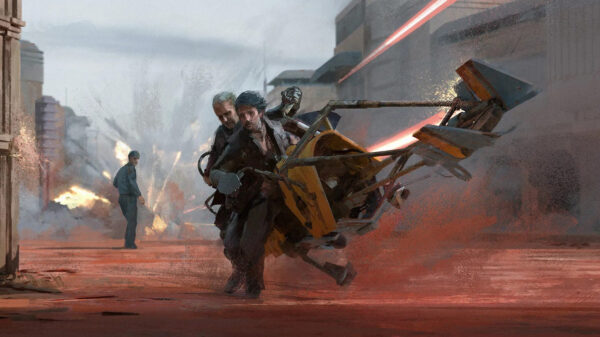
Stellan Skarsgård’s Luthan Rael’s Haulcraft ship was inspired by James Bond’s iconic Astin Martin with all its hidden gadgets. Lasers, space daggers, hidden compartments- it’s the Millennium Falcon on steroids in terms of surprises.
To help perfectly blend Andor’s real-world look with the Star Wars galaxy we grew up with, the Lucasfilm archives were an indispensable resource to the art team, particularly drawing inspiration from unused original designs throughout Star Wars’ existence.
The Imperial Battle Cruiser seen over Segra Milo, the planet of Saw Gerrera’s season 1 hideout, was an original Imperial Star Destroyer design. Cantwell class, named after its designer Colin Cantwell. Only previously seen in hologram form in Solo: A Star Wars Story, Luke Hull and ILM VFX supervisor Mohen Leo felt it was time to bring this original concept to life to battle Luthan’s powerful little haulship.
Droids, of course, are a hallmark of the Star Wars universe and perhaps the hardest to pull off. The designers of any Star Wars project are tasked with making its main droid character like nothing we’ve seen before. Cassian Andor’s droid B2EMO (inherited from his adopted mother Maarva,) quickly became a fan favorite as voiced by actor Dave Chapman.
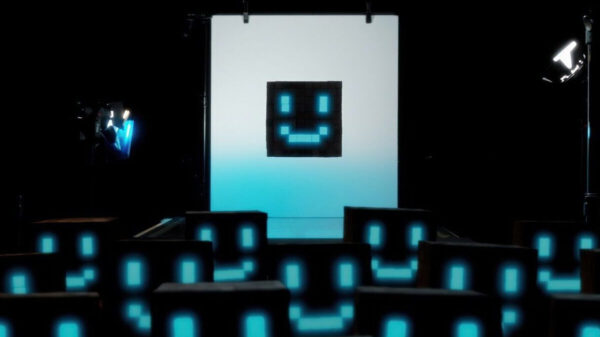
B2EMO was originally conceived as a type of droid-dog but eventually evolved into a more practical design for a planet that strips gigantic out-of-service starships: a rolling toolbox. We’re treated to many of B2’s sketch forms before his one-eyed, box-shaped configuration on wheels was approved.
If I had only one critique of The Art of Star Wars: Andor, with the exception of B2EMO, most of the artwork and illustrations presented are the approved final forms with few examples of variations detailing evolution. I’ve been fascinated by initial concept drawings ever since Joe Johnston’s Return of the Jedi Sketchbook from 1983. But I didn’t mind the lack of them here as much. Szostak’s annotations of the thought process behind the look of each set, prop, and costume help me appreciate the art of the filmmaking process itself.
What truly sets this Art of Star Wars addition apart from the rest is the attention to every detail. Not to say that previous Star Wars entries didn’t achieve the same level of quality or attention. Andor just did it in a different way. It took the magic of Star Wars and made it feel more personal, as if the characters of Andor were us and as if we were there alongside the crew – making Star Wars.
Through Tony Gilroy’s inspiring words and the creative team’s enthusiasm for Andor, Phil Szoskak captures the magic of making Star Wars like never before in The Art of Star Wars: Andor.