







































EVEN BEETHOVEN, BACH AND MOZART, TOOK IN THE TAPPIN’ TOES ART…

I can say, unequivocally, that all the music I love and listen to got to me via the human voice.
Just like, of course, everyone else.
The two sources that most influenced me in my earliest tastes were my mother, who sang all the time, in recollection of her teenage years on impromptu bar bandstands during the three shifts a day years of the Second World War. She gave me the lifelong gift that keeps on giving, namely the American Popular Songbook, which, despite all my resentment of her for her all too many failings, I remain grateful.
The second was my cousin Alan, who loved doo wop and street corner harmony with a religious devotion, and evangelized this music to me from my first unguarded moment. Like so many of his time and place, Alan was a casual and constant racist, who, despite this, had a Mount Rushmore of Clyde McPhatter, Ben E. King, Otis Williams, and Leroy Griffin. Go, as they say, figure.
(Spike Lee got this so damned right on the money that when I saw the exchange between Mookie and Pino in DO THE RIGHT THING, I laughed out loud.)
So the American Popular Songbook, and Acapella informed my musical tastes from word one…and Cowboy Poetry, too. Give a listen to The New Lost City Ramblers’ Tracy Schwarz’ chilling rendition of “TEXAS RANGERS,” as just one example, to see what I’m talking about.
So in the beginning was the word; even though, in some cases, the word was a string of nonsense syllables that, despite that lack of coherent meaning, carried emotional weight. You don’t get “…IN THE STILL OF THE NIGHT…” without “SHOODOO SHOOSHOOBY DOOBY WAHH…”
So, Lambert, Hendricks, & Ross, AKA, in their time, as per their second LP record, “THE HOTTEST NEW GROUP IN JAZZ!” there was a name for what this trio was doing, and that name was Vocalese…which had its precedents decades earlier…
…First, of course, with Louis Armstrong, who scatted, inspiring an entire subsection of singers and singing, among the best, and a few of the worst, too. Anyone with any curiosity knows about Pops; the very center of the mandala.
And then there was Leo Watson, a drummer and trombonist, who, inspired by Louis, improvised insanely—see his wildly eccentric NAGASAKI, as a prime example.
And then there was The Mills Brothers, who became, at a certain point, Mills, father and sons, who imitated the sound of musical instruments in their harmonies.
And then there was Dave Lambert, who with Buddy Stewart, who died shortly thereafter, who recorded “WHAT’S THIS?” ostensibly the first bebop vocal, just after the Second World War came to a reasonably satisfactory solution for so many people.
And then there was Eddie Jefferson, an eccentric—and yes, that word pops up here frequently—dance act, who traveled with a portable record player and wrote lyrics to jazz instrumentals to pass the time in his hotel room.
Jefferson started performing these—and call them finally, what they are—vocalese lyrics in his act.
And then there was Clarence Beeks, who renamed himself King Pleasure. He’d tended bar at one of the saloons where Jefferson performed his dance and vocalese act. He then hijacked the act, and hightailed it for New York City, where he had a brief popularity and recording career, featuring Jon Hendricks, Blossom Dearie and Betty Carter for a few duets.
And then there was Babs Gonzalez, who likely got the idea from King Pleasure, who added lyrics to Bird’s ORNITHOLOGY. Note—this might have been the least interesting aspect of Babs’ career. His real last name was Brown—it became Gonzalez so he could enter segregated clubs and spaces, passing as a Mexican. He was briefly Errol Flynn’s driver. He hawked his Hipster’s Dictionary at funerals. A biopic waiting to made, for fuck’s sake.
And yes, I digress.
And then there was Dave Lambert—again!—with The Dave Lambert Singers, who show up on Bird with Strings.
And then there was Annie Ross, a Glaswegian, who’d been a charter member of the Our Gang Comedies twenty years earlier, who wrote lyrics to Wardell Gray’s TWISTED and Art Farmer’s FARMER’S MARKET.
And then there was Jon Hendricks, yes, again, who had an idea.
He brought this idea to Dave Lambert, hoping, assuming, that Lambert’s chorale would be the place to realize this idea, but this went nowhere.
I have no idea who suggested Annie Ross to Hendricks and/or Lambert, but someone did. And Annie Ross, well, she got the idea.
And thus, LAMBERT, HENDRICKS & ROSS…SING A SONG OF BASIE.
The idea was simple in its expression, complex in its execution. Many of those acknowledged above had pointed at this idea, had demonstrated its possibilities, but none before Jon Hendricks had exhibited the audacity, the specificity, and, yes, the ambition, to take it to the limit.
First and foremost, Hendricks homes in on the Count Basie Orchestra, sixteen men swinging, and its celebrated All American Rhythm Section, as the rock upon which to build his church.
So to speak.
Hendricks brought in a rhythm section—piano, bass, drums and guitar—to cover that most necessary quarter of that mighty orchestra.
And then, once that was established, his genius took over, as, first he embraced the newly minted idea of overdubbing. And then, he wrote lyrics to these instrumentals.
And to be clear, as he’d already established his craft and craftiness with his brilliant take on that most Basie influenced post war big band, Woody Herman’s First Herd, a swinging orchestra that came equipped with that most Lestorian saxophone section, FOUR BROTHERS, these lyrics were coherent, specific, witty and often fiendishly clever.
So…
Dave Lambert, with his experience leading his choir of singers, covered the arrangements. Then, with that engaging baritone, he became the trombone section.
Jon Hendricks essayed the middle range of the trumpets, and the tenor saxophones.
Annie Ross delivered on the top range of the trumpets, and the alto sax.
With that above mentioned recently perfected audio technique of over dubbing, these three were able to recreate the call and response, the trading fours, of those sixteen men swinging their asses off.
The album was a huge hit, and made this trio stars in their world. After recording another disk for another small label, this time with the Basie orchestra itself(!), they made the leap to the big time with Columbia records, where that “Hottest new group…” description was declared.
They recorded a number of records for Columbia, did the festival circuit, showed up on the hipper television variety shows; ages ago, my pal David Burd gave me a cassette tape of their astonishing take on Steve Allen’s theme, THIS COULD BE THE START OF SOMETHING BIG, lost to my world when my shit box car was broken into.
We can only hope that junkie thief was a jazz vocal fan.
Annie Ross left the group, and, as I recall, the country, over personal issues. Albert Goldman, in his biography, LADIES AND GENTLEMEN, LENNY BRUCE, never names her, but describes her, and spells out just what those personal issues might have been.
She was replaced, first by Mary Ann Moss, then Yolanda Bavan. The trio pushed on, but, at least for me, the fire was gone.
Dave Lambert died dreadfully and pointlessly on the Long Island Expressway in 1966, an act of kindness resulting in his death.
Jon Hendricks spent many of his last years trying to recreate that inimitable sound, with family and friends. He died, well regarded and revered, in 2017.
Annie Ross died in 2020, after a second career of smallish parts in movies, including, of all things, SUPERMAN III.
SING A SONG OF BASIE wasn’t the first jazz album I ever owned, but it was, in its way, a true gateway to understanding the music in a deeper and more coherent fashion. Like all those singers I listed at the top, to which I would have to add The Swingle Singers and Bobby McFerrin, Lambert, Hendricks & Ross taught me how to listen, as opposed to merely hear, music that remains challenging, to engage with complexity for the joy it holds.
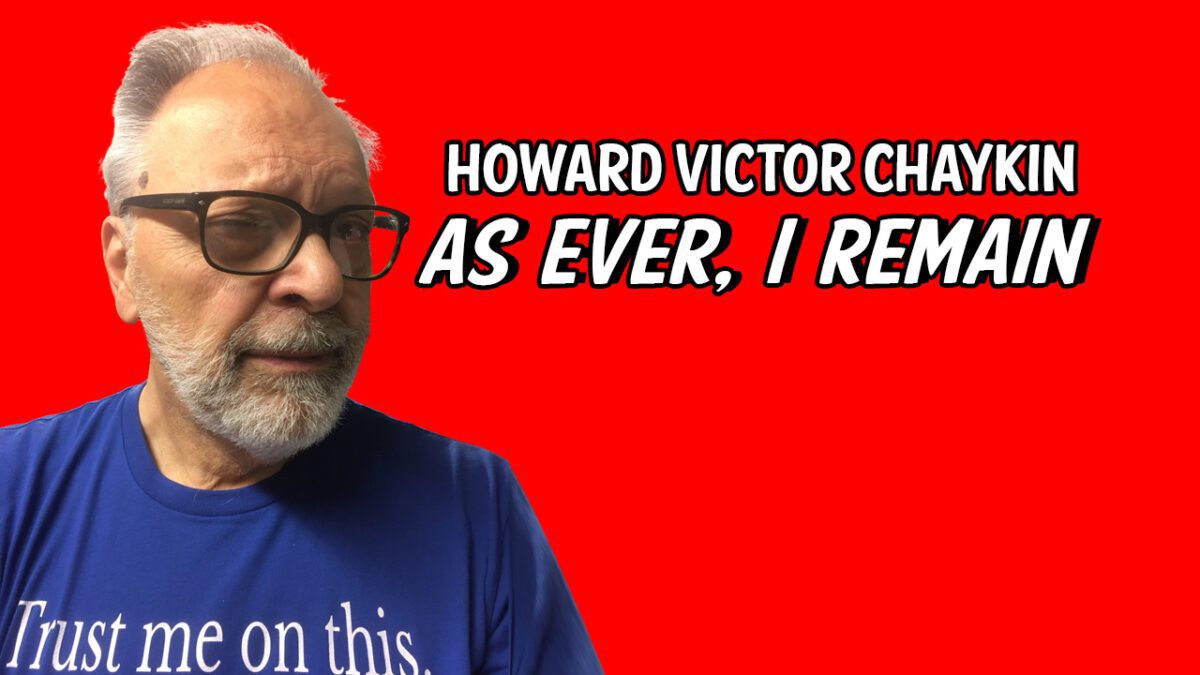
Trust me on this.
As ever I remain,
Howard Victor Chaykin…a Prince.