







































Decal Releasing
Halfway through Steven Soderbergh’s The Christophers, an art movie becomes a heist movie.
Maybe the director of Ocean’s Eleven just couldn’t help himself, particularly since he was working with Ed Solomon, the screenwriter of Now You See Me.
Or maybe there’s just no other way to make a movie about painters nowadays. Nobody knows what a painting is worth anymore.
All we know is what it sells for.
Time was that Hollywood epics about great artists were big on suffering. Lust for Life, The Agony and the Ecstasy, Moulin Rouge (no, not the one where Ewan McGregor sings Elton John), Camille Claudel, Vincent and Theo, even as late an entry as 2000’s Pollock all focused on the price of making art: insanity, alcoholism, poverty, permanent backaches.
The Christophers is mainly about the price you get for selling art. Specifically, art that may not be what people think they’re paying for.
Soderbergh’s original concept for The Christophers—the name refers to a series of uncompleted paintings that could be worth millions if the artist could just get off his aging duff and finish them—was a Patricia Highsmith-style psychological drama in the mode of The Talented Mr. Ripley.
In this version, a young and amoral assistant would have learned to copy her mentor’s work well enough to pass it off as her own. It would have put The Christophers in the realm of Orson Welles’s F For Fake—or, if you’re more into forged fiction, the sadly overlooked Can You Ever Forgive Me?
Movies like this ask a question: if the critics, the audience, and the buyers think they’ve got a real Picasso or Matisse, what does it really matter if they don’t? Does the painting suddenly become less brilliant, daring, or emotionally potent if it turns out to have been cooked up by some nameless forger in a loft?
Well, no, it shouldn’t. But it does become less valuable to billionaire tech bros who have a lot more money than taste. This is the direction Soderbergh and Solomon finally took us. They decided to follow the money.
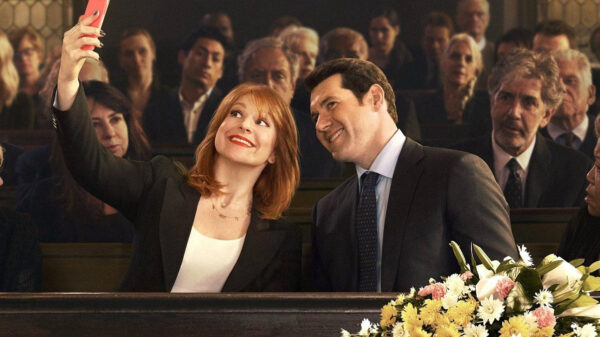
Michaela Coel plays Lori Butler, a once-aspiring artist whose art-restoration business is a front for her real trade in producing believable fakes. There doesn’t seem to be a lot of money in that: she has to interrupt a business call to serve up noodles from her London food truck.
But she’s just gotten an offer for serious cash.
A talentless art-school classmate (Jessica Gunning) and her slimy brother (James Corden) want her to take a job as assistant to their famous father, Julian Sklar (a role so plummy and crusty that it could only have gone to Ian McKellen). Her real mission will be to find the missing Christophers and finish them in Sklar’s style so they can be sold to one of those tech bros I just mentioned.
This is where The Christophers has a chance to become a truly remarkable film.
Lori doesn’t just know Sklar’s work: there was a time when she absolutely worshipped him. As a budding artist, she even got a chance to have her work rated by him on the BBC. Unfortunately for her, he was in just too snarky a mood that day. Instead of actually looking at her painting, he went for the cheap shot on live TV: the paint looked like it was crying out from the canvas, “What are we even doing here?”
So now Lori has a chance for money and revenge. By finishing his last great works—maybe even better than he could—she can prove herself superior to the artist who humiliated her. Of course, if she succeeds, then the world will never know that. They’ll think the old man had it in him after all.
Ironies like this are the stuff of great drama, particularly when Lori unexpectedly finds herself feeling sorry for Julian Sklar. The first two Christopher series (named for the male model who posed for them) made his fortune, but critics and dealers abandoned him when he couldn’t finish the third.
Sklar was forced to sell his remaining inventory in a yard sale and now scrapes by doing Cameo-style video sessions and portraits on demand, like that amusement-park cartoonist who will draw you with a beach body if you pay him twenty bucks.
And Lori has to admit she sees a little of herself in him. They each left painting for different reasons—and he did have something to do with her downfall—but the point is, they both gave up.
The plan nearly derails on day one when Julian announces that Lori’s first duty as assistant will be to shred—no, scratch that, burn—the unfinished Christophers.
Usually, it’s not a compliment when you say that a movie feels stagey, but in this case it works. Soderbergh shoots and cuts the exteriors conventionally (as he always does, under the respective pseudonyms of Peter Andrews and Mary Ann Bernard). They feel arthouse-small: not bad, just not worth remembering.
But the moment Lori steps into Julian’s studio, the safeties are off. The camera’s handheld. Entire ten-minute scenes play out in single takes. We are watching two phenomenal actors act.
Reportedly, McKellen and Coel were the director’s first and only choices for Julian and Lori, even though he’d never worked with either of them and they’d never worked with each other. Both actors were jamming their performances in between previous commitments, so the whole thing had to happen in eighteen days. Time restraints forced Soderbergh to trust his two leads and they do not disappoint.
McKellen has made a late-stage career of playing dangerous mentors: even before he was leading Bilbo and Frodo into peril, he was a dark muse to Brad Renfro as an aging Nazi in Apt Pupil, Shakespeare’s patron in All is True, and the seductively decrepit director James Whale in Gods and Monsters.
As Julian Sklar, he wields his gruff charm to devilish effect. Even in his dying embers, you get the sense of who Julian must have been in his prime. The kind who could lure pretty young things before his easel and into his bed, who could lift your soul to heaven or shred your hopes with a single word. Like many brilliant artists, he doesn’t see why anyone should complain. Didn’t they want to be near him? Well, this is what moths get for flying too close to the firelight.
Since we first see Sklar speaking into an iPhone, haloed by a ring light, he obviously knows his way around technology. It doesn’t take him long to Google Lori and figure out she’s an art faker posing as a fake assistant—but inside that art forger, a real artist is trying to be born. He has all the proof he needs when she can’t bring herself to put a match to those unfinished Christophers.
Soderbergh has said in interviews that he made The Christophers because he just wanted a no-pressure, arthouse flick in between blockbusters. It’s how he started out with Sex, Lies & Videotape, and he gets this way every few movies: for every Magic Mike or Ocean’s Twelve there’s a Schizopolis or The Good German.
If Soderbergh had stayed on the latter track and done the scary thing, The Christophers could have led us to some interesting places. The essentially fucked-up power dynamic of all mentor relationships. The hard question of whether any successful artist is brave enough to say no to his fans. The even harder question of whether any of us can win a battle against the imaginary career we never had.
Instead, Soderbergh and Solomon go for the caper.
The first half of The Christophers asks, “Are these paintings worth saving?”
The second asks, “How will they pull this off?”
Once her deception is exposed, Lori nearly walks out—then turns and asks Julian if he’d like to help her pull off the fakery. It’s played low-key, but not all that differently from every other heist movie Soderbergh’s ever made. I wouldn’t have been that surprised to hear Ian McKellen come back with Rick & Morty’s parody-catchphrase, “You son of a bitch, I’m in.”
I wouldn’t call this a disappointment so much as a missed opportunity. Up till now, we’ve been seeing the film through Lori’s eyes. Wondering if he might have been right about her lack of talent, or she should have let him get to her like that. Wanting to hate Julian and discovering she can’t.
But of necessity, caper films have to keep us guessing about the protagonist’s true intentions. Which con is she working here? Is she playing Julian and his greedy kids for saps? We’re locked out of Lori’s thoughts just as we were starting to know her. Worse, Julian literally disappears from the film before his character arc can pay off. We never find out if he had that last masterpiece in him.
I suspect that Soderbergh made his switcheroo for the same reason so many films about artists choke up. Movies have a hard time explaining how genius works. Amadeus plays into the myth that Mozart simply transcribed music he’d already composed in his head. A Beautiful Mind’s John Nash literally sees intricate patterns of numbers floating around. Pollock shows the artist dribbling random squiggles of paint on a big canvas while his patron Peggy Guggenheim beams: “You’ve done it, Jackson. You’ve broken it wide open.” In other words: who knows how they do it?
The Christophers has its own version of a paint-squiggling scene. Julian tries to deface one of his own paintings by covering it in glue and glitter and accidentally winds up making it unforgettable. How do we know? Lori tells us. We never actually see the painting. He rips it up before the camera can show it to us.
The message seems to be that genius is more about self-confidence than talent. The painting’s waiting to be born, you just have to get out of your own way and let it happen. It’s a convenient myth of genius for our everyone-is-special age, one that replaces the old suffering-artist canard without improving on it.
The truth is that art isn’t about self-confidence any more than it’s about self-immolation. It’s about curiosity, love, frustration, stubbornness, technology, hard work, luck, introspection, and time. As in, having enough of it to spare on all those other things I mentioned instead of working some dead-end job to get by.
Which means that yes, it’s about the marketplace. Cobalt blue costs money. As Mozart’s dad advised his famous son, it’s all well and good if the emperor gives you a snuff-box, but the landlord doesn’t accept snuff-boxes for rent.
The closest The Christophers comes to recovering its potential is when Lori finally thinks to ask the question that’s so obvious, it’s even in the title: who is this “Christopher” who inspired the paintings? Just a vessel for Julian’s genius, a pretty boy to flatter and seduce, or something more?
The film’s Christopher series seems to have been inspired by Andrew Wyeth’s Helga paintings, a previously unknown cache of works depicting a mostly nude woman whose chief asset seems to have been her total lack of affect. She is the blank canvas against which the artist projects his genius.
This could have added a whole new dimension to The Christophers—but, once again, Soderbergh backs away from his own question. Lori tracks down “Christopher”—not his real name, it turns out—and asks why Julian called him that. The camera cuts away before he can answer. Not since Forrest Gump’s microphone went out during his Vietnam speech has a movie chickened out this badly.
When the “new” Christopher series finally makes its debut, all the questions the movie’s been asking get a chance to be answered, which they’re not. Who was the real Christopher? Are the paintings what Julian would have done if he’d finished them, or is Lori simply imposing her own style on his? Who’s the real artist here?
All left by the wayside. The only answer we get is that the value of Julian’s catalogue has just shot through the roof.
But that’s Steven Soderbergh for you. He’s the kind of indie maverick you can trust with a big-budget popcorn flick. Whether that means he knows how to make art is undetermined. The money always wins.
Extras include trailer and a Conversation with screenwriter Ed Solomon and Charlie Kaufman.