







































There are some fantasy, science fiction, and horror films that not every fan has caught. Not every film ever made has been seen by the audience that lives for such fare. Some of these deserve another look, because sometimes not every film should remain obscure.
Sometimes, though, you have to admit than even an extraordinary woman can’t fix some messes…
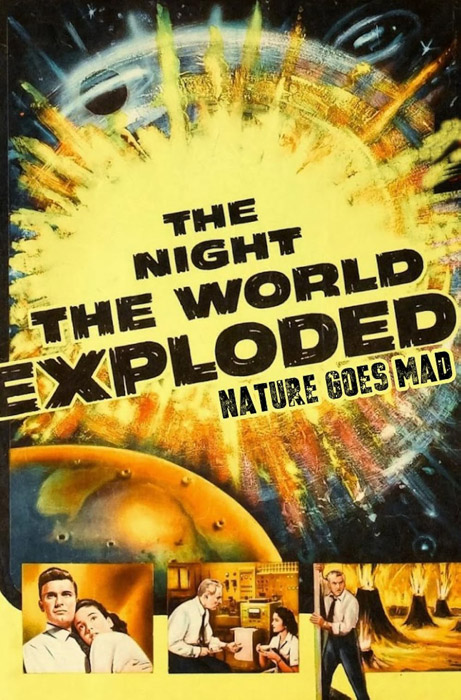
The Night the World Exploded (1957)
Distributed by: Columbia Pictures
Directed by: Fred F. Sears
It’s tough being a woman in the sciences.
The challenges today are daunting. There’s a bit of the old boys club that dissuades women from contributing; according to UNESCO, women make up only 35% of all students studying STEM, and the ones that stay with it face gender discrimination and lack of representation in their field. And this is supposedly an improvement over how women scientists were treated in the mid-20th century, as what happened to Rosalind Franklin was more often the norm than the exception.
It’s hard to imagine with that occurring in the real world, that female characters in STEM in SF films in the 1950s would have it any better. It’s hard to find a film with a woman scientist where she doesn’t just step back and let the boys do all the work while serving as eye candy.
Hard, but not impossible…
Our film opens at the University Seismology Laboratory, suggested but not explicitly stated to be in the Los Angeles area. As the establishing shots screen, the narrator sets the scene for us:
Those who lived to tell the tale remember that the day began with fragile, breathtaking beauty. The temperature was cool, air mountain pure…a day unreal enough to serve as the setting for the birth of the world or the death of it.

The day starts with Dr. Ellis Morton (Tristram Coffin) being greeted by the office assistant, Laura “Hutch” Hutchinson (Kathryn Grant). She lets him know that their colleague, Dr. David Conway (William Leslie), wants to see him. Hutch lets Morton know that Conway has spent all night on his pressure photometer, a machine that in theory could predict earthquakes. Worried that his colleague is burning out (that morning was supposed to be Conway’s day off), Morton confronts him.
Conway needed to see Morton for two important reasons: One, the pressure photometer is now working and operational. And two, according to the machine, there is a major earthquake predicted to occur in the region within 24 hours. This requires a quick trip by airplane to speak with Governor Chaney (Raymond Greenleaf) to get him to evacuate the region.

The governor is hesitant to put people in a panic because an untested device has given him a dire warning that may not pan out. Nonetheless, he takes some precautions, putting emergency coordinators on site to be ready, much like FEMA used to do before-
Must. Resist. Obvious. Comment…
The good news/bad news is that the pressure photometer is accurate, which means thousands of deaths in the region. The governor, in the midst of rescue coordination, has a meeting with Conway and Hutch, where things get worse: Conway’s machine is predicting a quake twice as strong to hit the area within three to four days. And according to Conway and Hutch, there will also be additional quakes around the world, a portent of something dire to come.

To improve their data collection, the team at the seismology lab bring their pressure photometer to Carlsbad Caverns, to get better readings by going deeper into the crust. With the help of park ranger Kirk Brown (Fred Coby), they set up base camp close to 1400 feet below sea level.
After some delay thanks to Hutch having an acrophobic attack on the way down to base, which Connor helps her through by deriding her sex and telling her to just cry on her way back to her parents (a set of insults that make her mad enough to come on down to show him what for), the work begins. While down there, Kirk finds a strange rock he’d never seen before. He claims the rock as a collector, and Connor happily encourages him to take it home for study, where he makes some startling finds…

Kirk’s last moments consist of watching his rock sample expand like a sponge in water, then heat up until it explodes. He and his shack are gone, and its only Connor and Hutch having a similar but less deadly encounter with the new material, christened “Element 112” as it was the first empty step in the periodic table to be slotted in to.
But Kirk’s sacrifice was not in vain, for now, the scientists of the world know what is happening: Element 112 is making its way through the crust, where gravity (their words, not mine) has been lessened in spots where oil wells and deep mining has occurred. When this material comes into contact with air at the surface, its expansion triggers earthquakes, which are augmented with explosions far greater than an atomic bomb.

Can the scientists of the world come together to address this global menace? Can the nations of Earth find the cooperation they need to handle what Hutch realizes before everyone else in the pic does, a crisis that’s as she puts it, “almost as if Earth the earth were striking back at us for the way we robbed her of her natural resources”?
Which isn’t a bad way to look at it. The film’s science is badly askew, but before anything else, there’s one plot point that’s held up pretty well. The dangers and damage caused by hydraulic fracking could easily be inserted into a remake of the film with very little dialog needing to be changed, and as mining for rare earths increases, there could certainly be more such instances that would fit easily into such a film.
But that’s about all that the film gets right. The big bad element breaks so many of the laws of thermodynamics that if convicted would be looking at 25-to-life for such crimes. Also, you don’t just shove an element you discovered into the periodic table just because there’s a place for it. (As for the real Element 112, that turned out to be Copernicium, a radioactive synthetic chemical element, that earned its place in 1996 because of its properties, not because it called dibs on an empty bunk, thank you…)

“Kathryn Crosby, nee Grant, and Bing Crosby, 1957”
About the only other scientific element they got right was Hutch’s poor portrayal in the film. She’s called the best assistant that both Morton and Conway have ever had, and as noted does provide insight and effort in dealing with the crisis. That said, one of her main motivations in the pic is her attraction to Conway, who takes most of the film to realize that she’s fallen for him. It’s tripe, and feels especially unwanted when Hutch talks to Morton about her turning in her resignation so that she could get married to another man (offscreen), which both diminishes the character and plays to the old joke about women who only go to college for their MRS.
What makes this especially egregious is that Kathryn Grant headlines the film. Her name is above everyone else’s, a rare thing among most films without A-list talent, especially SF B-films. The fact that she is the star and still gets a character that has to shut up and let the boys run the show makes it especially galling to watch.

Ironically, Grant was cast as a woman where love got in the way of her career just as she married Bing Crosby in October of 1957, four months after the film’s premiere. Unlike her character, however, she would not quietly disappear when the boys showed up. While she took less film roles after her marriage, in 1963, she found more work in television, and completed her studies to be a registered nurse.
In the 1970s, she would go on to host The Kathryn Crosby Show, a morning talk program on KPIX-TV, which at times featured Bing as a guest:
There’s nothing to indicate that Bing ever saw Kathryn in The Night the World Exploded, but had he, it’s easy to imagine that she would have left quite an impression on him. Of all the talent on camera, despite Jack Natteford and Luci Ward’s uneven script and Sears’ uninspired direction, she manages to find something to work with while the rest of the cast are comfortable coasting in their trope-defined parts.
It’s probably easier to conclude that no one saw the film. The movie was the B-feature that Columbia released on the bottom of the card with The Giant Claw, one of the most derided atomic monster films ever put on screen. With nothing spectacular to offer audiences and tied to a literal turkey, the film quickly disappeared from memory.
This is probably just as well. Having fewer examples in media of women not being good in the sciences and thinking about their marriage before their career will hopefully allow for them to make up more than 35% of STEM studies in the future. Even if the science in the film was impeccable (which was never going to happen in a Columbia B-pic), the example shown could have depressed enrollments in such programs.
It’s already tough being a woman in the sciences without this getting in the way…