






































There are some fantasy, science fiction, and horror films that not every fan has caught. Not every film ever made has been seen by the audience that lives for such fare. Some of these deserve another look, because sometimes not every film should remain obscure.
Sometimes, you might get a chance to choose which three spirits will visit you before Christmas; if you do, don’t pick these guys…
Beyond Tomorrow (1940)
Distributed by: RKO Radio Pictures
Directed by: A. Edward Sutherland
The Christmas Movie: The cinematic version of the holiday fruitcake.
Some people will enrobe themselves in lots of these the way a holiday reveler will wear an ugly Christmas sweater without irony. Some will try and buck expectations, and cite Die Hard as a Christmas film.
(And if you do feel this way but want to have a good film for a double feature night, maybe Things to Come might fit the bill…?)
And sometimes, a Christmas Movie can be like the occasional fruitcake that is worth having a few bite of:
Again, that’s “sometimes,” which means this one, by comparison, well-l-l-l…
No, must. Resist. Obvious. Comment.

Apparently, their parlor also serves as their office, as we watch George Melton (Harry Carey) and Allan Chadwick (C. Aubrey Smith) working on specifications with their staff for a project they’re doing in Pittsburgh. They might have kept their drafters and stenographers right through the whole night had not Michael O’Brien (Charles Winniger) shown up with presents in his arms. Gifts are then exchanged, which even Melton who calls Christmas “a merchant’s holiday” appreciates. (O’Brien receives a cigarette box that plays “The Wearing of the Green” when it opens; make of that what you will…)
Despite almost working through the night, they did have plans: The three gents had invited a couple they are friends with to share dinner at their home that night. These friends cancel on them, however, which means falling back on just going to their club for the night, until O’Brien gets an idea: They put ten dollars (about $193 in today’s value) into a spare wallet, along with a business card, and throw them out the window. If anyone returns the wallet by seven PM, they get invited to dinner with them that night, which means someone’s going to enjoy the feast overseen by Madame Tanya (Maria Ouspenskaya), a former Russian countess who fled the Revolution back home, aided by her retainer Josef (Alex Melesh), the butler.
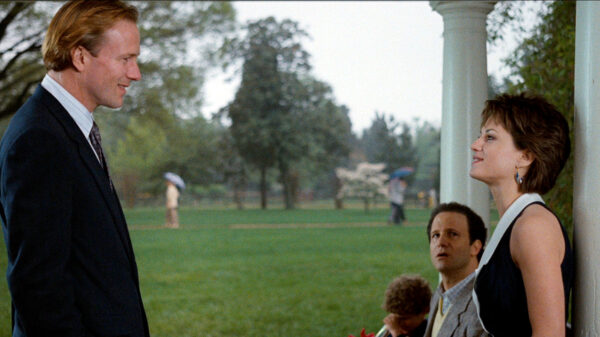
And of course the plan works; they get two honest folk to return the wallets they found, stranded in New York cowboy James Houston (Richard Carlson) and teacher at the orphanage Jean Lewis (Jean Parker). Jimmy and Jean start hitting it off right away, which is not as big a surprise as the characters face when they find out that James can sing.

The next day, the architects show up at the orphanage to entertain the kids with James in tow, and soon the five of them are inseparable. They celebrate New Year’s together, they go bowling together, you’d think after we watched all that studious goings on about the Pittsburgh project that opened the film that they decided to bail on that for these two.
But, Pittsburg needs them, desperately, and so the three architects take a flight out there, promising James and Jean to be back soon. Which doesn’t happen, as the plane plows into a mountain during a storm with no survivors.

Though return they do, as spirits, who watch over the two young lovers, who were going to tell the three architects once they came back about their engagement. Thankfully, O’Brien had the foresight to leave a little something to James just in case, which gets picked up as a story by the radio studio.

While at the station, James runs into major radio celebrity Arlene Terry (Helen Vinson). Arlene’s impressed with his singing voice, as well as his pipes, ifyouknowwhatImean. She starts to seduce the young man, hoping to have him replace the gent who is currently her partner, both professionally and otherwise. This causes our three ghosts great consternation, which they have to address soon, as the Great Beyond starts calling them to leave this realm and take their place in the afterlife.
And no, they don’t explain why they waited so long to tell them their number is up…
There’s a lot that’s inexplicable here, the logic for anything taking place seemingly reduced to “Hey, just roll with it, willya?” It goes from sentimental to gloomy at its own pace, all the while with an unbearable sweetness permeating everything. The only ones to face more overwhelming concentrated sweetness than any viewer of the film were the survivors of the Great Boston Molasses Flood.
The biggest problem with the script by Adele Comandini (who was also the film’s associate producer) from a story by Mildred Cram is not so much what it serves up, but how hard it crams it down your throat. There’s so many plot threads that keep pushing each other out of the way for our attention, and before we can decide if we’re on board, the next one rushes forward. The end result is an uneven film that doesn’t allow you to get that comfortable with it.
The only certainty you can gain out of watching this is that Sutherland had a hell of mess to try and neaten up. On the plus side, he handles the technical requirements well as far as giving us ghost on screen and how they interact with us and the Hereafter. It’s not quite the visual poetry we’d get years later in Ghost, but it holds its own in comparison.

The same can’t be said of some of the company, though. Jean Parker comes across a bit too wan as the love interest/female lead, far too passive even after O’Brien’s pep talk to her to get her to fight for her lover. Winniger’s O’Brien over-relies on Irish stereotypes to give us a sense of his character, and the other principals who normally got supporting roles in B pictures didn’t give us enough reason to want to see them carrying other projects. (The biggest exception being Carlson, who ultimately lands the lead in Creature from the Black Lagoon.)
The end result was a present that didn’t get a lot of returns. It never built up much of a fan base the way It’s a Wonderful Life did. When this movie fell into public domain, it didn’t get as many runs on TV the way the other film had, enabling Capra’s work to strike a chord with viewers and get declared a holiday tradition. While the later film’s creators fought to put it back under copyright, there wasn’t enough interest in Beyond Tomorrow to have it fill all the broadcast windows the other no longer showed up in.
So like residents of the Island of Misfit Toys, this film never got that much love. As a result, it’s not likely to displace anyone else’s choice for Christmas movie to watch every year, like say A Christmas Story if you love a traditional film for this time of year.
Let alone something outside of that box, like Black Christmas…