




































Paramount Pictures
Some legends are even larger than they appear.
All you have to mention is a girl, a gorilla, and a skyscraper and people know who you’re talking about. Beauty killed the beast. The first horror movie that was also a heartbreaker.
And then in 1976 they went and remade King Kong.
What Dino De Laurentiis said at the time is now part of that legend—and he really did say it before Belushi parodied it on SNL: “No one cry when Jaws die. But when the monkey die, people gonna cry.”
Less frequently quoted is what he said next: “Intellectuals gonna love Kong. Even film buffs who love the first Kong are gonna love ours. Why? Because I no give them crap.”
You throw down a gauntlet like that, Dino, somebody’s gonna pick it up.
Is the Bicentennial-year Kong a treat for Sorbonne eggheads and readers of Cahiers du Cinema? Does it rival the RKO classic? Did the producer of La Strada and Army of Darkness in fact give us crap?
Well, no. It’s not awful. It’s sprightly compared to Peter Jackson’s Return of the King-length 2005 remake. It’s even got a message. But that’s the problem. Horror generally doesn’t do messages well. That’s what disaster movies are for.
And that’s exactly what King Kong became in 1976. Not quite a disaster. But a disaster movie all the same.
It was unavoidable. Pretty much every big-budget 70s epic had to issue some kind of potent warning to society. Like all disaster movies, this one revolves around three characters: somebody’s got to be right, somebody’s got to be greedy, and somebody’s got to get rescued.
Kong’s know-it-all is Jeff Bridges as Jack. In the original, Jack is a gruff but dashing first mate, a man of adventure in a torn shirt and sailor cap. Here, Jack’s job is whatever the plot needs it to be: a photographer with a year of med school in case somebody needs patching up, a preachy environmentalist, a good man in a fight, and a primate paleontologist. Not a lot of postings for that on LinkedIn, but how lucky that this expedition turns out to need one. Jack’s shaggy mane and Van Dyke make him look like The Dude before the White Russians found him.
This being set at the height of the energy crisis, greed arrives in the form of Fred Wilson, a petroleum executive for Petrox (a play on “Pet Rocks” for anyone old enough to remember them), who just knows there’s oil in them thar undiscovered islands. There is, but the movie forgets all about that the moment the big guy shows up.
Fred’s no impresario like Carl Denham. When he meets a 40-foot ape, all he can see is a company mascot that will put the Exxon tiger to shame. Charles Grodin is totally miscast in the part. If you needed someone to play a nebbishy amoral WASP (as in The Heartbreak Kid or Heaven Can Wait), Grodin was your guy. But he’s just not up to the part of corporate villain. The dollar signs barely flicker in those deadpan eyes.
And then there’s Kong’s blonde girl: Jessica Lange in her big-screen debut.
As the star attraction in another mid-70s horror flick asked, “Whatever happened to Fay Wray?” Well, she was reportedly offered a cameo role but hated the script. Kim Basinger, Bo Derek, and Meryl Streep all auditioned for the female lead: Streep recalls De Laurentiis saying “che brutta” (how ugly) when he thought she couldn’t understand him and was gobsmacked when she replied in flawless Italian how sorry she was not to be beautiful enough for him.
It’s hard to imagine America’s greatest actress wriggling in Kong’s mighty hand in hot pants and a crop-top. But then, it’s hard to imagine a time when Jessica Lange was considered nothing more than a sex kitten. Her character seems to have been designed not just to inflame Kong’s passions but to defy all logic.
She introduces herself as “Dwan”—that’s Dawn with two letters reversed—which I guess was screenwriter Lorenzo Semple’s way of making fun of mononymic celebrities. There being no other way to justify a bubbly airhead on an oil tanker, she literally floats into the movie on an inflatable raft. She was on her way to make a film in Singapore when her producer’s yacht blew up and never mind, she’s in the story, okay? This is the girl. Dwan.
Rounding out the cast are some of my favorite that-guy actors of the age: Rene Auberjonois as a petroleum scientist who won’t shut up about seismic detectors; John Randolph (Prizzi’s Honor) as the affable skipper; Jack O’Halloran (Non, the “mindless aberration” from the 1978 Superman), who at 6’ 6” is officially the movie’s second tallest character; Ed Lauter, who has played just about every high school coach, cop, and Army guy over the past fifty years; and a very young John Lone as a cook.
Did I leave anybody out? No, not unless we’re talking about the title character. And who plays him? Well, that’s where the controversy starts.
As all film buffs and intellectuals know, the 1933 King Kong was a pioneering triumph of stop-motion photography by Willis O’Brien. De Laurentiis initially wanted another stop-motion genius, Ray Harryhausen, to do the honors but the Clash of the Titans director said there wasn’t enough time.
Thus it was that, a year before Star Wars completely reinvented special effects, De Laurentiis boldly announced that his leading man would be played by a 40-foot robot.
Carlo Rambaldi, who would create his own legend in Alien and E.T. The Extra Terrestrial, could not afford to build for strength: like the great ape himself, his true adversary was gravity. So he constructed Kong out of lightweight aluminum, Styrofoam, and (no lie) Argentinian horse tails.
If you wanted a movie to stand out in those days, you needed to give people something they couldn’t find on their TV sets. So the first big press event for King Kong featured Jessica Lange sitting in a six-foot mechanical hand Rambaldi had built for closeups (Lange apparently disappointed the press by refusing to scream).
The problem—also part of the greater Kong legendarium—is that Rambaldi’s considerable talents just weren’t made for scale. The giant robot couldn’t perform and, apart from one sixty-second shot, is barely in the movie at all. So who’s that monkey?
De Laurentiis had scoffed at the idea that Kong would be just some idiot in a gorilla suit, and in a way he kept that promise. There would be a gorilla suit but the guy inside was no idiot: the great Rick Baker.
For reasons that can only be attributed to Dino’s vanity, Baker’s name was kept off the credits, which meant that he didn’t get to share in the Academy’s special award for Rambaldi and crew. It was such a big deal at the time that two members of the AMPAS special effects board resigned in protest. Baker’s exclusion was both an injustice and completely unnecessary: his work is brilliant.
Baker saved the day with a suit that was designed to help him mimic (I force myself to avoid writing ape) natural simian movements, and above all to be expressive. If everybody gonna cry when monkey die, then the monkey better show some emotion. It’s all in Baker’s own eyes, hidden behind contact lenses.
This matters. Kong was not a special effect, it was a performance, one that absolutely had to work. You need that wounded look in Kong’s eyes just before he falls off the Empire State Building.
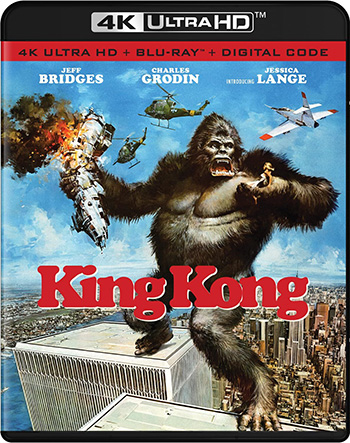
Or in this case, the World Trade Center. That was another of Dino’s little stunts, one whose tragedy lands differently fifty years on. Back then, the WTC was considered an eyesore, a crass one-upping of New York’s most famous building. The 1976 poster made a big deal of Kong literally straddling the two towers.
Which was all for naught. Like the robot, the WTC is barely in the movie at all.
So what does it give us, this mid-70s King Kong? Kind of a mishmash.
Like that Jaws movie that De Laurentiis pooh-poohed, the 1976 King Kong had all the classic disaster tropes: corrupt officials who assure us that everything’s under control, screaming crowds when that turns out not to be the case, stern warnings that you mess with nature and it’ll mess right back. Throw in Raymond Burr and the city of Tokyo and this could have been Godzilla.
That apparently wasn’t enough for Lorenzo Semple, who thought that no modern audience could take movie monsters seriously (he only had to wait three years for Alien to prove him wrong). Semple conceived his script as a sly parody of celebrity culture. Thus we’ve got Lange forced to be bubbly as the ridiculously named Dwan, longing to stand in the spotlights and getting her wish in the worst way possible.
But De Laurentiis wasn’t about to let his ape go Howard Beale on us, even if he was mad as hell and not going to take it anymore. He wanted a modern upgrade and armies of spear-throwing savages and, well, he got them.
Like O’Brien’s other claim to fame The Lost World, King Kong isn’t the dawn of a new kind of storytelling so much as a farewell to an older one. Its wonders are those of Jules Verne and H. Rider Haggard’s Allan Quatermain: white explorers seeking treasure and adventure in the dark jungles, holding fierce creatures and rapacious natives at bay with bang-sticks.
We get them on cue in the 1976 King Kong, as Fred Wilson’s petroleum-hunting crew sneak into the walled village to find oil welling up from the ground like Jed Clampett’s bubblin’ crude. Wilson rubs his palms together and send the captain back to grab some trinkets to trade with the ignorant savages.
Only Jack dares ask, um, so what’s up with that wall? Supposedly the natives have been plugging it for centuries. Better they should have plugged some plot holes.
Like for instance, if that wall’s been up for that long, does that mean there’s a whole race of giant gorillas? Is Kong immortal? If they’re trying to keep Kong out, why make a door big enough for him to get through? Why are they using petroleum to grease the gatepole when they could just set Kong on fire instead of sacrificing their finest maidens to him?
Keep in mind that this is an uncontacted tribe. And yet the moment they lay eyes on these bizarre new people they’re not thinking, what the what? They take one look at Dwan and say, wow, white lady, that’s a way better sacrifice. How much for her? Jack gets the job of translating all of this even though he clearly does not speak a word of their native language. His job is Smart Guy, so he has to go by pointing.
Jack is supposed to be the enlightened one in the group, but he speaks a line that manages to be sanctimonious and racist. Fred observes that the natives will probably be glad to be rid of Kong, but Jack disagrees. “You’ve taken away their god.”
The rest of the movie is Kong classic. The natives kidnap Dwan, Kong falls in love with this cute white Tinkerbell lady instead of eating her, and Fred traps Kong in the hold of the oil tanker so he can take the creature home for his Broadway debut. Kong gets loose, somehow gets Dwan’s address even though she’s not in the book, and carries her to meet his doom in the urban jungle.
What made the 1933 King Kong so poignant is that he wasn’t actually all that savage. The actual bad guys were those dinosaurs that also lived on Skull Island. When Kong rescues Ann Darrow from the T-Rex, he climbs up a curiously skyscraper-shaped mountain and swats away the pterodactyls. It works because Kong is in his element. When he tries to climb a mountain-shaped skyscraper and swat away biplanes, it’s tragically ineffective.
So despite what Denham wryly observes, it wasn’t Beauty that killed the Beast. It was a failure to adapt. Tactics that work in the wild just won’t cut it in the Big Apple. Nature is to be pitied for its inability to cope with modern technology.
70s disaster epics turn the moral on its head. Modern technology isn’t the solution, it’s the problem. Our skyscrapers catch fire too easily and our astronauts bring diseases back from outer space. Whatever we’re doing, we need to stop.
The 1976 King Kong is a fun trip back to 70s kitsch but it seriously needs to pick a lane. It wants to advertise how in touch it is with the modern world and it wants to indulge in colonialist fantasies. It wants a thoroughly modern Fay Wray and it wants her to be a helpless damsel in the grip of a giant rubber hand.
De Laurentiis wasn’t a storyteller, he was a showman. It didn’t matter to him if his movie made no sense. He just wanted to go big. Big skyscraper. Big ape. Big emotions. Big time.
It is big. But bigger isn’t always better. Let the record show that I did not cry when monkey die.