


































For as popular as epic fantasy has become in our current phase of cinema, few films have actually tried to render myth with real poetry and mystery.
Excalibur, directed by John Boorman forty five years ago, does exactly that.
Excalibur opened to modest success and a mixed critical reception in its day: it was always recognized as being well acted and visually striking but the fractured dialogue and episodic meandering script didn’t land for critics in 1981.
Taken half a century later, the film’s refusal to soften the sharp edges of myths is inspiring. And while its middle third briefly loses some of the propulsive force and awe of what bookend it, the overall achievement remains laudable and unique.
The story opens on the great Wizard Merlin (played by Nichol Williamson) as he advises Uther Pendragon (Gabriel Byrne), a lord trying to unite Britain in the Dark Ages. When Uther uses Merlin’s sorcery to seduce and ravish a new ally’s wife he must forfeit the child Arthur to Merlin in payment.
Years later, the young Arthur (Nigel Terry) unknowingly draws the mystic sword Excalibur from the stone, revealing himself. He unites Britain, forms the Round Table, and ushers in a golden age alongside Guinevere (Cherie Lunghi) and the knight Lancelot (Nicholas Clay). Yet Arthur’s half-sister Morgana (Helen Mirren) schemes from the shadows to corrupt the Kingdom as the death of her father poisoned her soul. She mimics the circumstances of Arthur’s birth to trick him into giving her a son, Mordred (Robert Addie) destined to destroy the fellowship of Camelot forever.
Boorman’s greatest strength is tone.
He does not aim for historical realism or a cozy antiquarian medievalism. Instead, he works in archetype and bold, powerful emotion. The armor gleams unnaturally, forests glow with an otherworldly sheen, and Merlin speaks ominously of the world of the Old Gods coming to an end. Their performances have mythic weight wherein each character is utterly defined by simple choices.
When Arthur cracks Excalibur because he cannot abide losing to Lancelot we feel his despair when he laments that he is now unworthy to rule, because we’ve seen his father lose the mandate. Boorman effectively communicates to a modern audience that this isn’t a story about a sword but about striving to the moral excellence that accompanies it.
The opening third is particularly exhilarating.
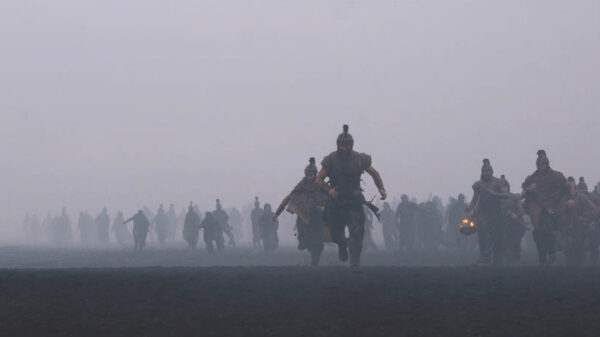
Uther’s campaign opens with knights charging through sheets of fire, Excalibur blazing against the dark has the feeling of illuminated medieval manuscript come to life. Boorman uses the music of the great composer Richard Wagner not as subtle accompaniment but as ecstatic reinforcement for the powerful mytho-poetic themes in play. The film’s operatic scale in these early passages gives it an almost biblical sweep. When Arthur pulls the sword from the stone, it feels less like a narrative beat than a cosmic shift.
The film’s visual language deserves special praise.
The film was originally to be an adaptation of Lord of the Rings shot entirely in Ireland, and it captures the magic of the Ireland of our imagination: mist hangs in valleys and otherworldly light pierces though dense canopies. The cinematography leans heavily into emerald hues, and every body of water is crystal clear. Excalibur itself becomes a character, symbolizing the mandate of the Christian God united with the will of the land itself to find a king.
The beginning surges with raw mythic energy and the final act pulls together all the tragedy of the end of the heroic age, the middle third is where the criticism about pace are somewhat valid.
Once the kingdom is established and the Round Table assembled, the narrative loses almost all the forward momentum. Boorman’s operatic style is very effective but it can make smaller moments feel labored over and flabby. Characters in myth embody ideas more than real personalities. As a result, the middle section where Lancelot’s betrayal and Morgana’s treachery are key is harder to sink your teeth into because it’s hard to empathize with a character who is more Idea than person.
Fortunately, the final act restores and even surpasses the early grandeur.
The Grail quest and the final battle reframe and echo the opening. In these scenes, Boorman’s symbolism pays off and the tragic heroism– the sense of powerful loss and heroic catharsis you get when you read something like Mallory or Tennyson is actually conveyed in a Hollywood movie.
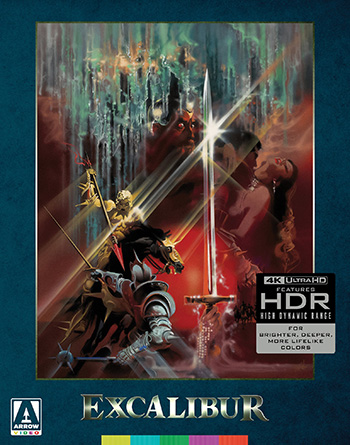
This 4K limited edition restoration includes both the theatrical and TV cuts of the film, multiple commentary tracks, Making-Of doc, interviews, featurettes, trailers, image galleries, retrospective documentary, collector’s booklet, art cards, fold-out poster, and art cards.
Highly Recommended.