















































There are some fantasy, science fiction, and horror films that not every fan has caught. Not every film ever made has been seen by the audience that lives for such fare. Some of these deserve another look, because sometimes not every film should remain obscure.
Sometimes, something so wrong can actually be pretty well right…
Moon Zero Two (1969)
Distributed by: Warner Bros. – Seven Arts
Directed by: Roy Ward Baker
Most folks probably have an easier time of doing this than Hammer Films did when they made their one big stab at science fiction…
We get a decent info dump as to the background behind the setting for the film through, of all things, an animated roll accompanying the opening credits:
Our film is set in the far-off year of 2021 (over a few days in May, to be precise). As the credits showed us, the space race is over, and has been replaced by the commercial exploitation of the solar system by the Space Corporation. The moon has been colonized, with regular passenger service from and to Earth, and there are settlements across the moon’s surface, for those deciding not to move on to Mars or Venus.
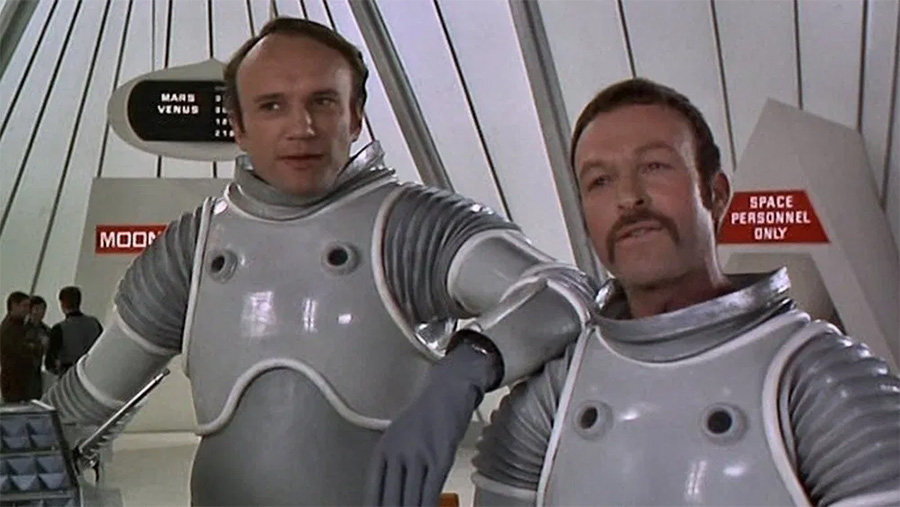
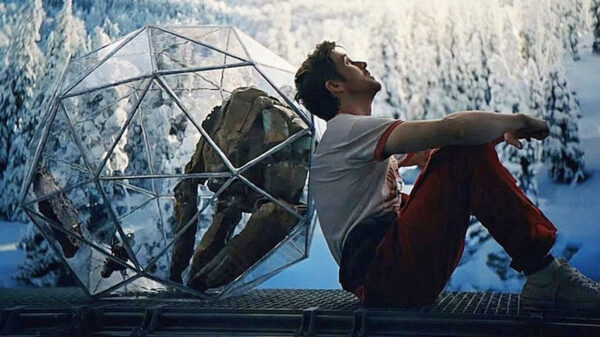
Among those staying on the moon are Bill Kemp (James Olsen), and Dan Karminski (Ori Levi). Bill, who we find out casually was the first man to walk on Mars, partners with Dan to work the salvage business in lunar orbit, picking up scrap with their spacecraft. The craft, Moo Zero Two, is a barely functional wreck that looks like it was cobbled together with left over parts when the LM was decommissioned. It may look ugly (and yes, it is), but it gets the job done.

Speaking of having a job, we soon get introduced to Clementine Taplin (Catherina von Schell) who’s come to the moon to look for her brother, Wally. She hasn’t heard from him in a while, which is understandable in that miners on the dark side of the moon tend to be incommunicado for-
Yes, I said “miner;” yes, her name is “Clementine;” so yeah, that was probably intentional…
Ultimately, Clementine meets Bill on the monorail, where he gives a small explainer to her about life on the moon:
Also found on the moon is J. J. “100%” Hubbard (Warren Mitchell), a wheeler-dealer who always seems to have a scheme at the ready. These schemes must be successful, considering he has an entourage that includes his muscle Harry (Bernard Bresslaw), his tech Whitsun (Dudley Foster), and his two pieces of unnamed eye candy (Simonne Silvera and Amber Dean Smith) ready to do his bidding, no matter how obnoxious he is.

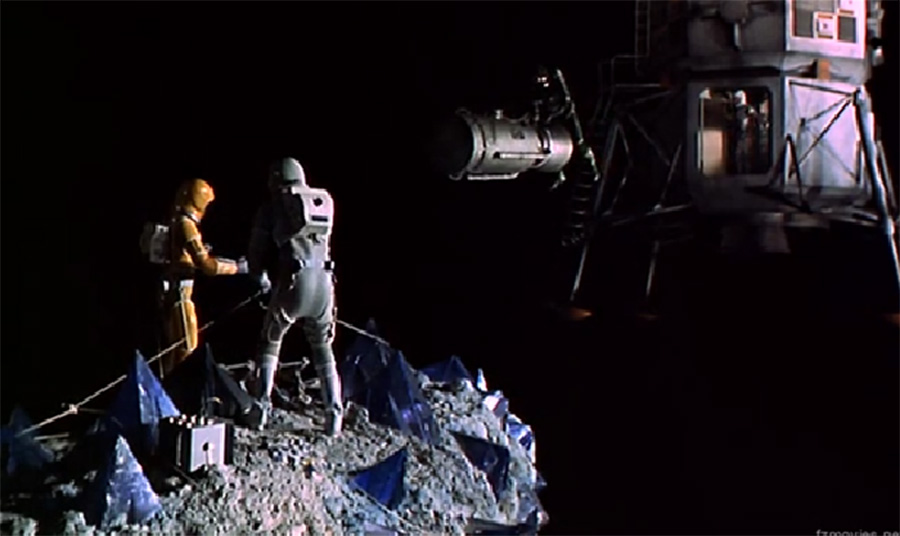
Hubbard’s latest scheme includes a job for Bill: He wants Bill to ferry Harry and Whitsun in the Moon Zero Two to intercept a rogue asteroid as it comes close to the moon. The asteroid is six thousand tons of sapphires, which Hubbard wishes to crash on the dark side of the moon without raising suspicions. In return, he can make Bill’s troubles go away, by allowing him to buy a new salvage ship that’s not about to fall apart. With a new ship, Bill’s girlfriend Lis Murphy (Adrienne Corri), who enforces the law up on the moon, can stop ignoring the pressure from the Space Corporation to shut down his unsafe operation, and maybe stop trying to convince Bill to get over the company’s shutting down their exploration arm, swallow his pride, and get himself a job flying passengers.
Bill takes the job, though in the middle of it he also helps oh mah darlin Clementine look for her brother Wally, which at one point necessitates having to hire a moon buggy to go find him on the dark said of the moon:
As Bill accompanies Clementine, he discovers that Wally’s disappearance and Hubbard’s wayward asteroid are connected in a way that even the best pilot in the solar system would have more trouble to deal with than he would while piloting the worst spacecraft around the moon…
Bill Kemp may be the best man for the job, but James Olsen was definitely not the best actor to play Bill Kemp. There’s an emotional void at the center of his approach to the character, one that keeps any spark from emerging as though it were originating from the wrong side of an event horizon. With everyone else who’s cast handling the material at least adequately, a given for characters that are strongly camp, Olsen’s inability to give us someone to care about as the tentpole for the film makes this a failure to launch.
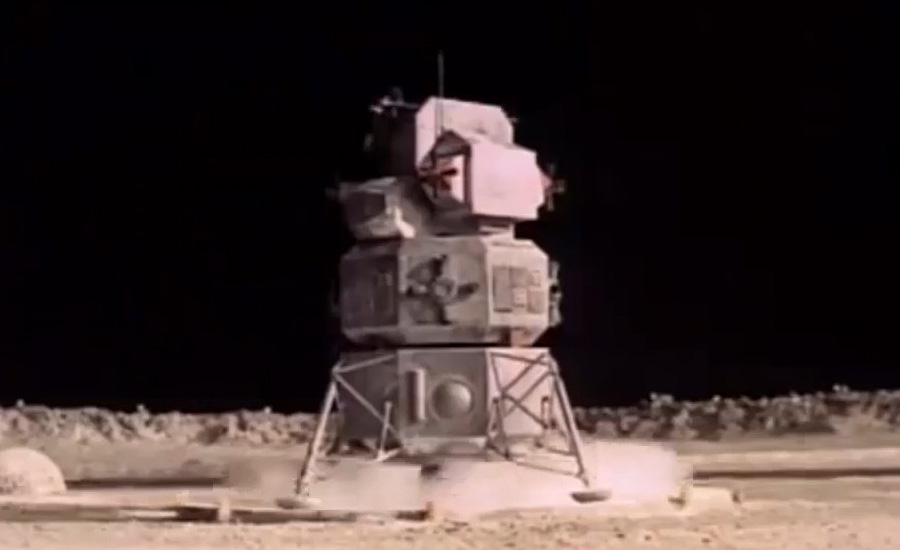
The film was likely doomed even before it was cast. The pic was based on a story penned by Martin Davison, Frank Hardman and Gavin Lyall, envisaged as a look at space travel once the shine of going where no man had gone before has worn off. There are plenty of references to this ideal in the script ultimately turned in by Michael Carreras, who produced the film for Hammer; characters talk about doing salvage and staying ahead of the authorities and their regulations, a kind of “wild west” vibe that the production team leaned heavily into with some of their set and prop choices. All of this helps when the film gives characters a chance to relay facts about space travel and conditions on the moon, details that they manage to get for the most part right.
Mind you, the script that came out of Carreras’ hands had a number of interesting points that can be appreciated in modern times. In their scenario, travel into space was turned over to large corporations who focused on the profit motive over discovery. Anyone following the exploits of Virgin Space, Blue Origin and SpaceX can easily relate to Kemp’s disgust with how our views of space travel have lost their wonder (even if they can never relate to Kemp himself).
Unfortunately, under Baker’s direction, any grit on this story of the moon of 2021 was sandblasted away, leaving shiny vinyl and industrial plastic in its place. Believing that audiences weren’t going to see a film about space that didn’t rip off emulate 2001, the aesthetic was a polished and gleaming universe, one where references to the space being just a job five days a week were at odds with what the viewers were seeing.

And all the trouble taken by the script to spout hard facts were often undercut with ridiculous visual flourishes, like gravity on the surface of the moon being 1G out in the wilds and human bodies compressing in a vacuum as opposed to expanding. These poor choices putting the movie at odds with itself were likely based on what was cheapest to put on film. (The budget for the film was reported to be 500,000 pounds, just under $14 million in today’s value.)
Because of fear that the audiences were too enamored of Kubrick’s spectacle, Hammer blew their chance to give us the first “hardhats in space” property, years before Alien and Outland (and to a limited extent Star Wars). They could have set a standard that The Expanse would have tried to live up to, but because they couldn’t decide on how to approach their story, they gave us a muddle about going to the moon. And coming a mere three months after Apollo 11 touched down on the Sea of Tranquility, audiences weren’t likely going to give them the benefit of the doubt about what they tried to do.
Hammer couldn’t make up their minds about how to stage this movie. It certainly wasn’t easy, and in the end not very kind…