






















































Sony Pictures
Moneyball may be the strangest baseball movie ever made, and not just because of how little time it devotes to actual baseball games.
It asks us to believe that the real heroes of America’s national pastime aren’t the guys on the field but the men making deals in the front office.
Is it entertaining?
Yeah, it’s great. Does that make it a good movie? Maybe we should ask what umpires mean when they make that call. “It’s good” isn’t about whether we like what we see. It’s about what actually went down.
By that analogy, the screenwriters of Moneyball—and Michael Lewis, who authored the book it’s based on—made a bad call.
Let’s start with what the book and the movie tell us.
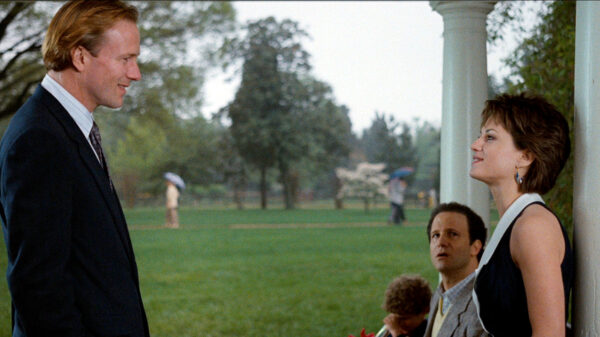
In 2002, Billy Beane (Brad Pitt), general manager of the Oakland Athletics—the “A’s”—comes off another losing season convinced that he talent problem: that is, a money problem. The Yankees have a $126 million budget for players, three times what the A’s can afford.
So we’ve got a David vs. Goliath story, a familiar theme in sports movies. It’s what happens next that breaks the mold.
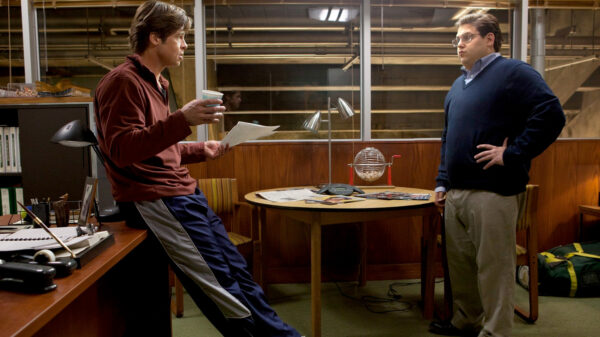
Beane crosses paths with Peter Brand (Jonah Hill), a Yale-educated statistician who knows nothing about baseball and everything about stocks and bonds. As far as Brand cares, that’s what players are: investments. Some are overrated, some are undervalued, and usually it’s because the market is looking at the wrong stats.
Brand convinces Beane that MLB teams are buying stars when they should be buying wins. In his math, wins aren’t about who wows the crowd or has the highest batting average. They’re about who is most likely to get on base. Load the bases and you win the game.
Beane uses moneyball (or sabermetrics, as it’s formally known) to commit baseball heresy, trading away proven players for what look to his scouts like damaged goods: a pitcher who throws funny but gets more outs for the money; a recently injured catcher that Beane turns into a first baseman.
Every story needs a villain. In Moneyball it’s not going to be rival teams, since that would mean watching actual games and this movie mostly plays out in offices and locker rooms.
Instead, co-screenwriters Stan Chervin, Steve Zaillian, and Aaron Sorkin concurred that Beane’s real adversaries are his own people: the aging scouts who care less about stats and more about whether players have the right “look” for the field (one of them says that a player’s “ugly girlfriend” shows a lack of confidence, apparently a verbatim quote from an actual scout).
Director Bennett Miller does not leave us to guess the moral. It’s not just that the scouts are old-fashioned in their thinking, it’s that they’re literally old. One of them has a hearing aid and the rest look like they saw action in Korea.
Meanwhile, grin-flashing Brad Pitt and nerdy young Jonah Hill are the future. They’re handsome and funny and understand undervalued investments. The old guys just stare back and grumble about passion and heart.
Once the season begins, the scouts’ job is done, and that’s when Moneyball shifts to a new bad guy: manager Art Howe (a stone-jawed Philip Seymour Hoffman). The A’s are still losing in spite of Beane’s ingenious trades, and we’re told it’s because Howe’s playing them wrong. He still has this decrepit notion that you should give the starting lineup to your best players or something.
There’s more to that story, but we’ll skip to the part everyone knows. The A’s go on to have their best season in years. But the real winner is moneyball.
Here we return to the umpires’ call. Is Moneyball off-base?
You would think that a movie written by diehard sports fans—Zaillian filmed chess like one-on-one basketball in Searching for Bobby Fischer and Sorkin couldn’t get through a West Wing episode without some bottom-of-the-ninth analogy—would insist on telling a story about why the A’s actually started winning games.
But instead of following the plays, they decided to follow the money.
Its source book is only partly about baseball. Michael Lewis isn’t a sportswriter, he’s an economist and former Salomon Brothers bond salesman who wrote Moneyball because he had a point to prove: namely, that whenever you’re talking about winning, you’re really talking about investment strategy. You take an underperforming stock and buy it on the cheap, you build up its value, and then you sell it for more.
So of course the hero of Moneyball is a money man whose job is to turn a profit, and that doesn’t happen on the diamond. It happens on the balance sheet, which makes star players an expensive luxury. If you can get more wins by paying the team less, you pay them less.
Except that’s not how the Oakland A’s actually started winning games again.
You will never find a harsher critic for your average sports movie than your average sportswriter. While the rest of us are misting up as the crowd cheers for Lou Gehrig or the mysterious voice says “If you build it, he will come,” people who really follow baseball are rolling their eyes about how an actor is holding the bat wrong or why Hatteberg didn’t actually start against the Royals, he just pinch-hit for Byrnes.
These people who actually know baseball (a group that includes luminaries like Jeff Pearlman and does not include me) aren’t grousing about technical inaccuracies. They’re pointing out flat lies that go beyond the filmmakers’ need to tell a good story.
This matters in any movie that puts “based on a true story” on the one-sheet, but it matters even more in baseball. Because baseball is supposed to be about fair play. And Moneyball doesn’t play fair.
The whole starting premise is wrong: Billy Beane didn’t introduce sabermetrics to baseball. That started under his predecessor Sandy Alderson. What Beane did was put it into high gear, and he got credit for proving that the model worked when the A’s built a twenty-game winning streak.
That’s a fantastic accomplishment. But it wasn’t all Beane’s.
Moneyball ignores that the A’s went into the 2002 season with their strongest starting rotation in years—including Tim Hudson, Mark Mulder, and Barry Zito—which manager Art Howe insisted on using the way you’re supposed to use your best players. Maybe that had something to do with winning, who knows.
Hudson, Mulder, and Zito barely appear in this movie. But then again, very few of the players get any screen time, and the ones that do (including a doe-eyed young Chris Pratt as Scott Hatteberg) are treated more as proof of Beane’s guts and genius than as characters with stories of their own. We don’t watch them train. We don’t see them sweat it out. We’re not with them on the plate or in the dugout.
This does not happen in sports movies. We’re supposed to watch the team come together and win the series. Coach gives a big speech. Legends are born.
Once in a while, the writers put Beane in the gym or the locker room to deliver the expected sermons. But mostly we see him on the phone, trading team members away for even more undervalued players.
But of course Beane wasn’t a coach, he was front office. He worked the phones like a pitcher works the mound. So you get a money hero in a money movie. Weirdly, it kind of works. Baseball is not good television and even worse cinema. But everybody likes to watch the dollars.
What’s harder to accept is how it rags on real, living people who actually were the heroes of the story. By all accounts, Art Howe was not only one of MLB’s most capable managers, he was also an old-school loyalist. He didn’t beg for the spotlight, he didn’t gripe about his contract (as the movie introduces him doing), and he actually delivered wins.
But Beane can’t be right unless Howe is wrong, and being kind of a sourpuss about it to boot. Hoffman plays Howe like he’s passing a kidney stone.
Movies are not documentaries. As long as we laugh and cry and cheer, they get to make things up. But that creates no obligation to lie outright. It is interesting to consider what Moneyball could have been, if it had stayed a Steven Soderbergh project.
Soderbergh’s idea was essentially to wrap a documentary around Moneyball, the way Band of Brothers does: the real people behind the story would show up as talking heads to explain what was going on and remind us what it all really meant. Some of the real Oakland A’s would even play themselves.
It could have been good and true. We’ll never know.
Sony put the kibosh on Soderbergh’s vision days before shooting. The studio wanted a guaranteed hit, not a noble experiment. Ironically, they got it by not playing moneyball with Moneyball: Brad Pitt earned $10 million for playing Billy Beane, a fifth of the movie’s total budget.
It’s fair to say Pitt earns it. He shines as a former ballplayer who squandered his chance at the majors because he wasn’t ready. He’s driven to prove himself and earn the respect of his daughter (Kerris Dorsey) and ex-wife (an underutilized Robin Wright).
This should theoretically make Beane a classic sports hero: he has the talent, he just needs to remember what the game is all about. But the lesson he learns is not what the game is all about. It may in fact be exactly what’s killing the game.
The real Billy Beane admits that his strategy only worked as long as other teams didn’t understand it. The minute that the Red Sox and Yankees started to copy his techniques, they had both the cash and the math to ensure that smaller teams like the A’s would never get close to a pennant again. The result: players get paid less and big teams become remorseless winning machines.
In online gaming circles this is known as min-maxing, powergaming, or just plain cheesing. Rather than chasing the spirit of the game, you chase the stats. Gamers hate these guys because they make the game boring. That hatred is deserved.
This is not exclusive to sports. Algorithms have infected lots of things that humans used to enjoy and now sullenly endure. Artists are expected to work for “exposure,” social media floods your feed with AI-generated slop, and… well, movies are what they mostly are now.
This was the unease that Moneyball left me with. While promoting itself as a story that celebrates risk-taking and (that oldest of sports-movie themes) believing in yourself, it actually represents the triumph of eliminating risk and believing only in the bottom line.
Entertainment studios have gotten this religion so hard that nothing gets greenlit unless it has “-verse” attached to its title. In 2011, the year Moneyball came out, 8 out of the top ten movies were either a sequel or part of a franchise. Last year it was 9 out of 10, and the only non-sequel was a paid promo for Formula One racing.
But risk is what the crowds cheer for. The thrill of seeing a player knock one out of the park—literally Moneyball’s emotional high point—only matters because it happens so rarely. Risk is life. In The Twilight Zone episode “A Nice Place to Visit,” a gambler realizes he’s in hell because he can’t stop winning.
In that light, it’s worth mentioning that if CBS had played sabermetrics with Rod Serling, The Twilight Zone probably wouldn’t have happened at all.
It’s a Moneyball world now. How many of us feel like we’re winning?
Extras include featurettes, deleted scenes and trailer.
To purchase this title click HERE.
This release is one of the thousands of titles available from Movie Zyng, official licensed home of The Warner Archive Collection. A small fraction of each purchase helps support this website.