



































 Written by Rachel Walther
Published by Headpress
Over the years, I have gone up and down on Al Pacino as an actor.
In the beginning, though, I was most definitely the former. I didn’t start my serious moviegoing until the Spring of 1973 so I had missed The Godfather, released a year earlier. I was also still only 14 and rather slight, thus I had to cajole a parent (either my own or a friend’s) into taking me to R-rated films.
That’s what happened when my Dad and I went to see Scarecrow in 1973, a now mostly forgotten road picture starring Pacino and Gene Hackman, both of whom were new faces to me then!
And I liked them! My dad did, too, so it wasn’t at all tough to get him to take me to see Serpico as well, which I liked even better.
Since, as noted, I had yet to see The Godfather, I skipped 1974’s The Godfather Part II for now but Pacino’s next one, with its saturation advertising, was 1975’s Dog Day Afternoon, and I was eager to catch it. Even from the commercials, you could tell this was not the soft-spoken performer with his subtle acting style as seen in his earlier films. I mean, yeah, Serpico could get tough but this guy was chewing the scenery on the commercials, even!
The plot of Dog Day Afternoon deals with a poorly planned amateur bank robbery gone awry in Brooklyn, with two very contrasting bank robbers taking hostages inside a downtown bank on a hot day when the police show up before they can get away. The tension mounts as they negotiate for their escape but something else also happens. Stockholm Syndrome. That’s the thing whereby someone in a bad situation (kidnapped, held hostage, like that) grows to sympathize more and more with the perpetrator to the point where they sometimes try to help them. In the movie, not only the hostages but the gawkers outside slowly take the sides of the hapless robbers.
Despite its controversial LGBTQ themes, director Sidney Lumet’s Dog Day Afternoon was a massive hit, and became one of the five films its co-star John Cazale made, all of which were nominated for Oscars as Best Picture. It was also nominated for a BAFTA and a Golden Globe.
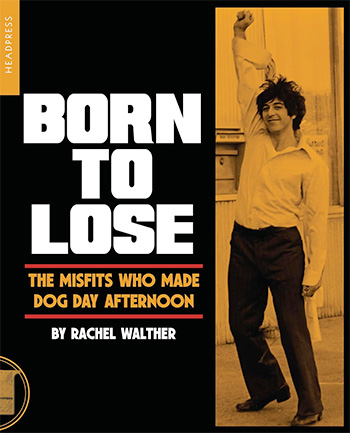
All that said…did you know Dog Day Afternoon was based on a true story? If I knew it at the time, I had long since forgotten. The new book Born to Lose: The Misfits Who made Dog Day Afternoon, by Rachel Walther, writes about not only the real true crime story behind it all but also the making of the successful movie version of the events.
It seems one John Wojtowicz, a former bank teller, himself, decided to rob a bank in order to fund his significant other’s gender-affirming surgery. Yes, that was a thing more than 50 years ago, too. One of his two accomplices fled immediately. The other helped him hold hostages for 14 hours, leading to what was described as a media circus. His partner was eventually killed and Wojtowicz sentenced to prison. Life magazine wrote about the actual crime and the movie was based on that article.
Walther does a good job of introducing us to the real-life people behind the robbery and telling us what was happening to them both before, during and after. Just like the event itself, she makes us sympathetic toward them. She does an even better job of digging deeply into the casting and shooting of the film. Even then, though, she tends to digress from time to time, sliding off-topic, for instance, to tell us at some length about the making of Streisand’s A Star is Born, for example, related as it has the same scriptwriter.
If you’re a fan of Pacino or even just of Dog Day Afternoon, you’ll want to read this book as this is probably the deepest dive into it all that you’re ever going to find. If you’re a true crime fan, it’s not the most bloodthirsty or thrilling crime to read about, though. Just a good solid read, Rachel Walther’s Born to Lose seems born to win, after all.
Booksteve recommends.