



































MUBI
My creative writing professor once told me that if you want to know where your story problems are, just pay attention to every time you say, “and then.” Those and-thens, he said, are like pulling a rug over cracks in the floor.
But that’s how real life is: a series of “and thens.” Most of us don’t get an arc.
Things happen and we adapt; we try something and maybe it works; we take a few chances and avoid others. Mostly we do what seems to make sense at the time. But unless we’re endowed with serious talent, money, thrill issues, or toxic levels of hubris, life leads most of us by the nose.
The History of Sound, much like the Ben Shattuck short story that inspired it, is the rare example of an “and then” movie that works.
Not because it’s based on a true story—it’s not—but because it feels like something that actually happened back in the day.
It’s the kind of tale you find in an old box of family letters while cleaning out the attic, a photo with a cryptic note on the back, a lover your grandfather never told you about. There are missing pieces and unfinished conversations. Episodes that you think will lead to something—a major epiphany, the key to another person’s heart—simply leave more questions than answers.
Directed and adapted by Oliver Hermanus, The History of Sound is an unfinished melody, a piano with missing keys. That’s what makes it glorious music. It sounds like real life.
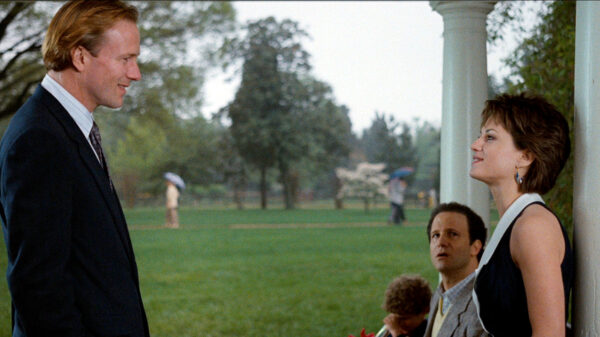
The story begins in 1910, as a young music student named Lionel (Paul Mescal from Gladiator II), blessed with perfect pitch and a collection of folk songs from his native Kentucky, finds a kindred spirit in a Brit named David (played by Josh O’Connor, familiar to fans of The Crown as a young Prince Charles). It turns out they learned the same ballad, “Silver Dagger,” on opposite sides of the Atlantic, and thought they were the only ones who knew it.
And this also rings true. Another of my college professors was a collector of folk songs, and he told me about hearing an obscure Appalachian fiddle tune called “The Bony Part of the Tree,” only to discover years later that it was better known in Ireland as “Bonaparte’s Retreat.” It’s the kind of connection you rarely expect, but the moment you make it, you feel history echoing in your veins.
This is what fuses Lionel and David, body and soul. Their physical consummation is treated not as something furtive and forbidden, just the natural thing that happens when two people find the same passion beating in both hearts.
Period stories about gay love usually come in one of two flavors: privileged and slightly soused (Brideshead Revisited) or rough-hewn and doomed (Brokeback Mountain). With David and Lionel you get a little of both—a rich Englishman falling hard for a rough country boy—and yet there’s no shame or self-delusion. Both of them seem to accept that eventually they’ll marry women and father children, because that’s what you do in 1910. But that’s all to come, the predictable next “and then.”
War separates them in 1914. David goes to fight. Lionel’s health keeps him out of the service, so he returns to his family farm. Six years later, he gets a letter from David, who’s apparently teaching at Bowdoin College: an invitation to travel America’s backroads and record folk songs for archival purposes on a wax-cylinder phonograph.
The beauty of this plot device is that research projects like this really did happen in the 1920s (though mostly they didn’t move into high gear until the Great Depression). Lionel and David sleep in tents, walk from village to village, and convince shy and secretive people to sing into David’s magical machine.
There’s a poignant moment when Lionel tries to explain to two children how the phonograph works and winds up explaining that sound moves through us, not just between us. A vibration in the air causes a vibration of a needle on wax. And within those wax grooves the sound is trapped, waiting to be released again.
As it happens, those particular sounds will have to wait not just months but decades to be heard. Soon after the project ends, David stops answering Lionel’s letters. Lionel reluctantly picks up the threads of his life. He takes a job as a choir director in Rome. There’s a romance with a local boy that clearly means more to the boy than it does to Lionel, because it doesn’t stop him from accepting another post in England.
Why he chooses England is left for us to guess—he says it’s because Italy is too hot in the summer, but it seems likely he’s trying to put himself on David’s home turf. Soon he’s involved with Clarissa Roux (Emma Canning), a free-spirited aristocrat who is smoothing a clear path to the altar with her parents’ blessing. We see Lionel and Clarissa making love, with no less passion or tenderness than he shared with David. In our label-obsessed age, we would be led to call Lionel bisexual or just extremely good at pretending. I suspect the lines were a bit blurrier back then.
The next “and then” is the death of Lionel’s mother, which calls him back to Kentucky, leaving both England and Clarissa in the dust. Eventually, inevitably, he goes looking for David. What he finds is something viewers deserve to learn without spoilers, but it’s worth the journey.
The History of Sound is not a perfect movie. I loved it, but I had to dip my toe in before deciding it was fine to plunge in. I fully expected to be bored brainless the moment I heard Chris Cooper’s narration as the older Lionel—voiceovers being the lazy screenwriter’s go-to for adapting literary fiction to the screen.
There’s a different kind of laziness in characters whose specialness is delivered by shorthand. Lionel (so he tells us himself), doesn’t just have perfect pitch: he sees music as colors and smells; he hears melodies in his mother’s coughing and the mating calls of tree frogs. We’re being told that Lionel is remarkable, which is asking us to take a lot on faith since he’s largely an inarticulate character, and mostly what we see him doing is running out on people the moment he senses they’re falling in love with him. It’s never entirely clear who they think they’re in love with, because his life’s one true passion—that backwoods trip with David—is just not going to come up.
And then there’s the and-then-ness of Lionel. You keep waiting for him to say he wants something, but mostly it’s other people (like David) offering him things to want. This is heresy for anyone trained on Syd Field and Joseph Campbell… but it’s usually how life works.
The moment you stop wanting Lionel to act like a protagonist and accept him as a person, the movie’s true magic begins to unfold. He has no words to explain what David means to him. They never talk about what happened to David during the war. They only discuss once if what they’re doing under the covers is right, or if it’s leading anywhere, and the conversation is never finished. Because it can’t be.
I suspect that every family has a Lionel or David somewhere in its scrapbooks. It’s often the bachelor uncle and his “friend,” but not always someone whose life can be summed up so neatly, if obliquely.
In my family it was my great-aunt Eloise, who died very young and of whom my grandparents never spoke. All I had of her was a hand-colored photo of a beautiful young lady with a fashionable flapper bob and the saddest eyes I’d ever seen. I kept the picture because I was drawn to her, even though no one seemed able to tell me anything about her, except that she’d died young. It was only years later that I did some digging around and got the whole truth—or as much truth as life was ever going to give me.
A newspaper article told me that Eloise had run away from her husband, a Navy doctor, in the company of a bootlegger from Chicago. Her escapades briefly made the national newspapers, particularly when she accused the bootlegger of murdering a rival gangster. Her story was apparently not believed by the authorities. By that time her husband was stationed in Nicaragua. She took a boat trip to see him, and less than a week later she was returning home alone when she apparently fell from the stern of the ship. Her death was ruled a suicide.
My grandparents never talked about Eloise when I was growing up. Except for that one photograph, it was as if she’d been lifted clean from our family history. I’ve since found pictures of my grandmother and Eloise embracing, smiling, clearly fond of each other. There is no sign of the girl who ran away with the bootlegger or threw herself into the sea. The pictures don’t add up to the story. In some ways, she’s more of a cipher now than she was when I knew nothing about her.
I pause to tell Eloise’s story because that’s what A History of Sound awoke in me. We think we’re looking at the mysteries around us, but really we are mysteries in the making. Even when we leave records of ourselves—a bundle of letters, a box of wax cylinder recordings, or a series of TikToks—the chances are very great that we will be remembered, if at all, as disconnected fragments. A nameless voice on a recording. An unopened and unanswered letter. A boy you spent a passionate season with and then never saw again. A girl you almost married but didn’t.
The world we live in now is very different from Lionel’s—not because it buries the inconvenient mysteries, but because it refuses all mystery. We distrust any love that refuses a category. We use social media and camera phones to document the minutiae of our lives, never once asking who’s going to wade through all that shit after we die. It preserves a delusion that our lives are definable and well-ordered. That we all have a narrative arc.
Lionel and David feel real to me precisely because their love is undefined and their lives are disordered. The older Lionel we meet in Chris Cooper isn’t summing up his life so much as making a collection of it, just as he collects obscure folk songs. The wonderful thing about collections is that they have no need to make sense. They are simply things to be wondered at.
In some ways, David is to Lionel what Jack was to Rose in Titanic: a brief encounter that changed his life. The only difference being that Rose’s post-Jack life is meant to seem grand and remarkable, worthy of Jack’s sacrifice; and Lionel’s post-David life is simply life. He met David. And then he lost David. And then he went looking for David. And then he found some part of David. And then.
This is what life is, and A History of Sound has captured a small piece of it: a series of and-thens, in which the randomness and incompleteness of life is its true wonder. We’re born. And then we love. And then we lose. And then nothing.