












































There are some fantasy, science fiction, and horror films that not every fan has caught. Not every film ever made has been seen by the audience that lives for such fare. Some of these deserve another look, because sometimes not every film should remain obscure.
Sometimes, you see a lot more than you’d imagine if you just look closely…
The Playgirls and the Vampire (aka L’ultima preda del vampiro) (1963)
Distributed by: Fanfare Film (in US)
Directed by: Piero Regnoli
The Italians have this word: tendenza.
Literally, it means “trend,” but can be used the same way the French use au courant or we use “having a moment.” It can be used to describe major cultural happenings in style and the arts, delineating moments big and small that are on everyone’s minds.
Like this one:
 While the term “romantasy” was only coined in 2023 or so, its elements go back much further in the past. Even though you could point to Elizabethan fiction (especially the works of Spenser and Shakespeare) to show how far bits of the tropes existed, not everyone wants to make so long a trip. As a result, they settle on Kresley Cole’s A Hunger Like No Other from 2006, Stephanie Meyer’s Twilight from 2005, or even Emma Bull’s War for the Oaks from 1987.
There are, however, a few stops that can be made long before you hit the end of the Tudors:
After the opening credits, which get interrupted for a shot of a sarcophagi being opened from the inside as a hand reaches out, we watch as a bus makes its way through the night. Aboard are a troop of nightclub dancers, managed by Lucas (Alfredo Rizzo). We discover through his conversations with his girls that he stiffed the last hotel they were staying at, making a trip through rough weather on a bumpy road necessary.
Considering that the girls, Katia (Maria Giovanni), Ilonia (Marissa Quattrini), Erika (Erika Dicenta), Magda (Corinne Fontaine) and Vera (Lyla Rocco), haven’t been paid either, Lucas is probably wishing that his roadie, Ferrenc (Leonardo Botta), took the girls on the bus while he found other means of travel that night…

The trip gets a little longer and rougher when they discover that the bridge is out, so they must take the road that goes by Kernassy Castle. The peasant that tells them the bridge is gone asks them not to do so, but Lucas can’t go back and face justice, so on they go.
They get to the castle and request to stay the night, but are told no, first by the groundkeeper Zoltan (Antoine Nicos), then by the one-woman house staff, Miss Balasz (Tilde Damiani). When they refuse to go, Count Gabor Kernassy himself (Walter Brandi) comes in and tells them the show must go on… to spend the night elsewhere.
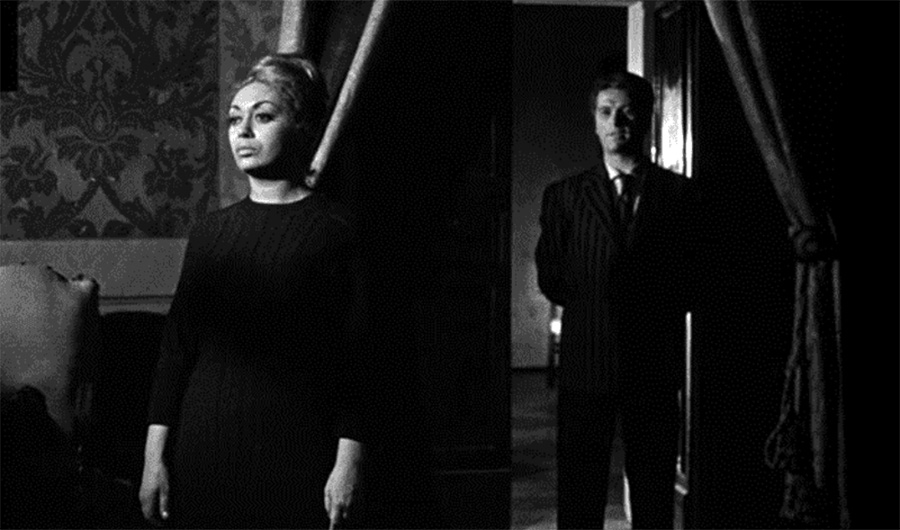
Vera, who seems to be very familiar with a place she’s never visited, comes forward to press the case, which causes the Count to retreat briefly before he relents. He grants them shelter for as long as needed, provided no one leaves their rooms at night and that they ignore any awful sounds they hear.
Not the most outrageous of requests compared to some Airbnb’s out there, but ANY-ways…
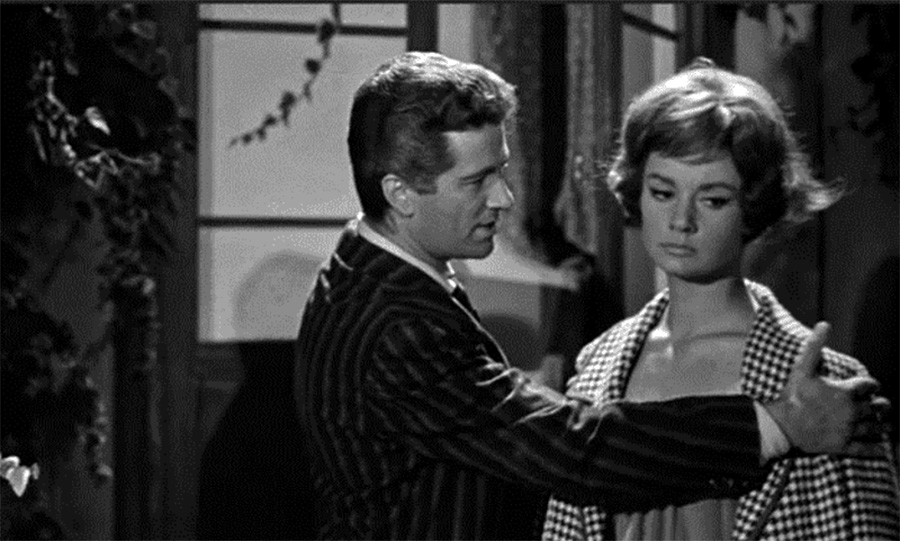
When Vera finds herself unable to sleep, she leaves her room and has a get-to-know-you-better conversation with the Count, who’s actually glad to see her out and about. When Katia finds herself unable to sleep, however, she finds herself in the attic, from where she has a fatal fall.
The remaining members of the troupe try and carry on despite Katia’s death, with at one point Erika auditioning a striptease she wants to add to the show. While the strip is going on, Vera finds something a lot hotter…

Vera comes across the portrait of Margherita Kernassy, an ancestor of the Count from the mid-1700s, just as the Count comes upon her. Their talk turns to deeper matters, and the two share their first kiss.
Things are going well for the couple until Vera takes a walk on the grounds at night, where she sees the Count standing over Katia’s open grave, her body missing. She calls to him before he goes back into the bushes like Homer Simpson, which complicates things.
It’s almost as big a complication as Katia’s return, without her clothes but with a thirst for blood.
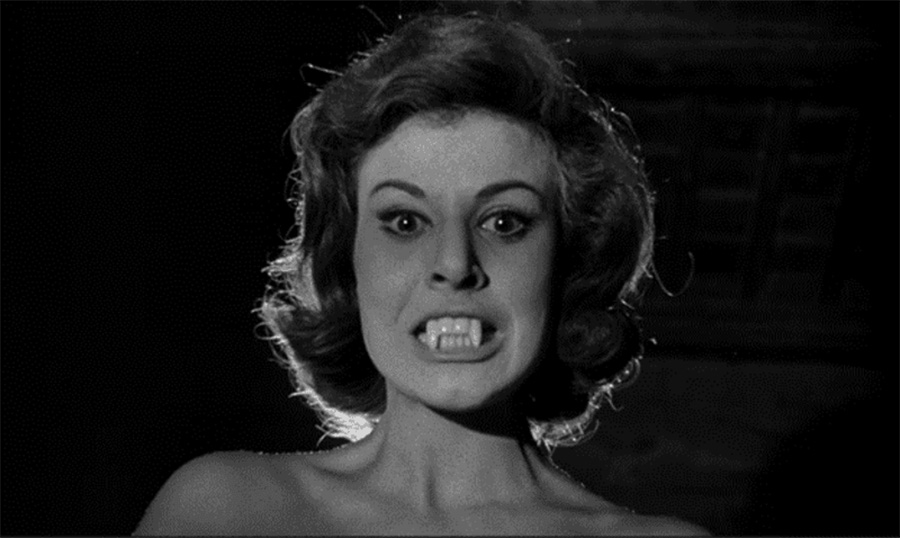
The story itself is not all that complicated. It’s a pretty standard ragazzo incontra ragazza / mostro incontra ragazza tale, complete with gothic sets and sensibilities. The creepy vibes, the creepy characters, it’s all here, all in service of a story of budding love, between two beings from very different worlds.
It’s not too spoilery to state that, this being made in the early 1960s, that not everything seems as dire as it’s made out to be. Regnoli’s script (excellently translated by Richard Gordon, who bought the English rights to the film, when it was released here in 1964) suggests a situation that doesn’t turn out to be as macabre as advertised. Some of it was likely the general sensibilities of the Italian film industry, and the fact that Regnoli was also at one point a film critic for L’Osservatore Romano, the Vatican’s newspaper, suggests some personal hesitancy.

Original theatrical poster for Italian release
That’s not to say that this is a film for the whole family. What probably convinced Gordon to distribute the film in the US and advertise it as an adult film are the plentiful shots of nipples and side boobs visible through the sleepwear the characters don for bed. The fact that vampiric Katia is completely naked (while the other vampire’s in a suit, which, Italian cinema) gives more than enough visual stimuli to make what might otherwise have been a pedestrian story more interesting.
The film could probably have stood on its own without showing us as much. Regnoli’s best shot has all the characters fully dressed, the camera set inside a just-dug grave as it looks up from the ground and pans all the mourners; it’s little moments like that that had there been more of them might have allowed the film to have a higher profile.

Theatrical poster for US release
Even if we’d gotten less skin, not as much brilliance as we could have gotten, and the pretty pedestrian players we’d have had anyway, the film is notable for what it does: It gives us a very early example of romanticy to cite. The elements in most romantacy works are present, the story beats line up as expected, and the general elements of the screenplay could easily find its way into the books from the small pub houses that the genre inspires.
After all, il romantasy è la nuova tendenza del momento…