

































Warner Bros.
Wuthering Heights is to England’s literature what The Great Gatsby is to America’s. People keep turning it into a movie while having no clue what it’s really about.
Emerald Fennell, who wrote and directed the 2026 version, does have a clue about Emily Brontë’s brilliant, narratively complex novel. She’s read the book. According to herself, she just didn’t feel like telling that particular story.
Wuthering Heights, or rather “Wuthering Heights”—the poster’s quotation marks seem to signal that this won’t be that novel you studied in English Lit—isn’t really an adaptation, Fennell says. It’s the story she wanted the book to be when she read it at the age of fourteen.
Young Emerald must have wanted some wild things, because her version starts with the sounds of heavy male breathing and creaking boards. As we pull back to show a hooded face, it turns out this guy’s not getting lucky. He’s getting hanged.
He’s also getting a boner (apparently this happens). The conjunction of death and eros is not lost on young Catherine Earnshaw, who’s raptly watching the execution while grownups grope each other around the foot of the scaffold. This is par for the course from the director of Saltburn. You will get wet on this ride.
Not always in a fun way. There’s blood on the screen and, this being set on the Yorkshire moors, a whole lot of mud and rain. Not exactly an ideal setting for romance.
But then, the novel was not written as a romance. It’s about people in love the way King Lear is about family values.
Wuthering Heights was Emily Brontë’s only published novel, but it was all she needed to prove her genius. It’s brilliant and brutal and strange. It dangles ghost stories at us. It prefigures modern literature with its reliance on unreliable narrators. It sideswipes England’s emerging capitalist class and the degradation of marrying for money, and it spans generations. It is a big book in every way.
Catherine’s obsession with the untamable Heathcliff—sorry to spoil, but she dies early in the book—is less central to the story than Heathcliff’s decades of self-immolating rage, status-hunting, and revenge on the genteel (but ungentle) folk who tormented him in his youth.
You could call Cathy’s fixation on Heathcliff a kind of love, although it comes off more like identity and boundary issues. “I am Heathcliff!” she tells her governess Nelly, who repeatedly fails to pry them apart.
Cathy might be Heathcliff, but Heathcliff isn’t exactly into Cathy, just deeply possessive. When she spurns him to marry the local squire Edgar Linton, it’s not jealously that fuels his rage: he was counting on her to be his ticket into polite society.
But that’s the book. Emerald Fennell’s movie exposes a different side of Cathy and Heathcliff, and I mean literally. I suppose that’s what really makes it a doomed romance: you spend all that time buck naked on craggy cliffsides and in drafty attics, you’re gonna die of something.
There is a deep stain of cruelty on the crumbling walls of Wuthering Heights, where young Cathy (Margot Robbie in her adult phase) has grown up under the heel of a vicious, drunken father (Martin Clunes) and a governess (Hong Chau) who “protects” Cathy by preparing her to exchange her father’s brutality for the tyranny of a husband.
One day, Mr. Earnshaw shows up with a beggar child. In the novel, it’s an act of kindness, but movie-Mr. Earnshaw literally uses him as a whipping boy. Cathy names him Heathcliff. In these early scenes he’s played by Owen Cooper, a real Yorkshire lad who stunned audiences as the young incel-murderer in Adolescence.
Sadly, Owen’s not in the film for long before he’s replaced by Jacob Elordi, an actor who seems too focused on getting his accent right to do much smoldering. We’re told that he and Cathy are soul-bonded—a lot—but in Fennell’s kinky hands it is all rough wooing. Mainly they shove each other against walls and throw crockery. She puts eggs in his bed as a prank. It’s like a sweaty Punch and Judy show.
Cathy has plans that do not involve starving while her father pisses himself on the floor. Apparently, they don’t involve Heathcliff either. When Edgar Linton (a plummy Shazad Latif) and his ward Isabella (Alison Oliver) move into nearby Thrushcross Grange—the most Victorian name ever given to any mansion—she determines to marry him. And determinedly succeeds.
A cheated and degraded Heathcliff literally rides off into the sunset, setting off what you might call the Cathy, what the hell are you complaining about? part of the movie. Edgar is the kindest man ever to be gold-digged. An adoring Isabella makes her a Cathy-doll: she confesses that she plucked its golden hair, strand by strand, from Cathy’s brush each morning. Margot Robbie’s wince of gratitude is almost enough to make me like Cathy.
Cathy now has everything she said she wanted. She got out of Wuthering Heights before it gothically collapsed on her. She got to throw coins on the floor so that her father would be forced to crawl after them (Martin Clunes reveals an unexpected talent for soused groveling). She’s got a big bedroom and a walk-in closet full of puffy dresses and she’s still got Nelly around to remind her how grateful she’s supposed to be. She has dutiful sex with Edgar and gets dutifully pregnant.
Then Heathcliff shows up, clean-shaven and inexplicably rich.
From here on there’s no point comparing the book to the movie. We are not in Brontë country but Fennelland, going where even Olivier and Merle Oberon feared to tread in the 1939 classic: straight to the bedroom or whatever surface is handy.
Messy, mucky sex is Emerald Fennell’s brand. Saltburn gave us a guy humping his father’s grave and another scene that, um, involves bathwater. Our first sight of it in “Wuthering Heights”—after the stiff with a stiffy, I mean—is two servants making inventive use of a horse bit and bridle.
So it’s oddly underwhelming when Heathcliff and Cathy finally give way to what they call passion. Partly it’s the setting: it’s got to be hard to perform in the drafty and cavernous rooms of Thrushcross Grange. Partly it’s because Elordi is both leaden and bloodlessly pale (more on that in a moment).
But mainly the sex is over-introduced and rushed, like they’ve got to make up for lost time: not because they didn’t seize their chance when they had it, but because the movie only has a third of the way to go and there’s a whole lot of adultery to do.
A drama teacher of mine once observed that even pornos need dialogue, if only so that the sex doesn’t happen all at once. Fennell did not learn that lesson. Once our two stars start going at it, they don’t stop. Add the music of Survivor and we’re not far off the training montage from Rocky III.
This is not to say that “Wuthering Heights”—Jesus, those air quotes—doesn’t have some steam. But it’s dark and sooty steam, and it happens between the wrong people: not Heathcliff and Cathy, but Heathcliff and Edgar’s naïve ward Isabella.
His seduction method is to crawl into Isabella’s bedroom sopping wet (when is he not sopping wet in this movie?) and promise that if she has sex with him and marries him, he will not only never love her, he will absolutely no-lie treat her like shit for no other reason than to torment Cathy. What girl could say no?
Not Isabella. She goes straight from pink hair ribbons to BDSM. Their power dynamic is even more effed-up than Heathcliff’s with Cathy, if such a thing is possible.
I’m not saying this because Heathcliff makes Isabella put on a dog collar and chains her to the fireplace. But it so happens there is a scene where Isabella is wearing a dog collar, and it does appear to be attached to the fireplace by some sort of chain.
This being a gothic tragedy, it is required that someone die tragically, and we already know who’s elected. It happens with little purpose or inevitability. Earlier, it was time for Cathy to commit adultery, and now it’s time for her to die. It’s an old trope in books and movies—adulterous women always die—and whether Fennell is a feminist or just really hung up on emo erotica, she feeds right into it.
Fennell’s movie has taken a beating among fans of period drama—mainly, I think, because it violates one of the cardinal rules of the genre: the lust always has to be veneered by some kind of gentility. The empire gowns. The kissed hands. Assignations behind the drapery. Waltzing with the landed gentry.
But in truth, its lack of polish may be the best thing Wuthering Heights (I’m done with the quotes) has going for it. It’s the only part that feels like Emily Brontë.
The Brontës were not landed gentry. They were cooped up in a poor Yorkshire parsonage, in rooms too small to contain their learning or their ambitions. And yet they were not the fey spinsters that folklore has spun them into.
When poverty sent them into the world, Anne and Emily and Charlotte got drunk on discovery. They explored foreign capitals, had obsessive (probably unconsummated) crushes on their teachers, served as governesses like Nelly, tried and failed to found a school for free-thinking young women, and finally chose writing because they’d run out of ways to put a few pennies together.
And they failed even at that, or so they thought: their first collaboration only sold two copies. Emily and Anne died before the world could appreciate them, and a grief-crazed Charlotte is said to have burned Emily’s second novel. That is tragedy.
The dreariness of the 2026 Wuthering Heights is the most Brontë-like thing about it. No one comes to parties at Thrushcross Grange. All the candles are lit, but they illuminate nothing. Out in the moors, black rocks slice through the ground like shark’s teeth.
Cathy stands against this like the doll-effigy that Isabella made for her. Experts on early Victorian dress have justly complained about costume designer Jacqueline Durran’s refusal to make the slightest nod at period accuracy. But there is a method to her misfires. Cathy’s clothes are her prison. Her corsets are laced so tight they draw blood.
From the moment of her engagement to Linton, Cathy is dressed almost entirely in white: accented, in ever-increasing amounts, by scarlet cloth and roses and ribbons that presage her bloody death. Cathy is not in Victorian dress because she’s not a Victorian lady. She’s an apparition, a ghost waiting to be called back to the grave. The white of her wedding dress becomes her shroud. She is too wan for this world.
And speaking of that.
Fennell’s casting is color-blind, something that shouldn’t have to call attention to itself and mostly doesn’t. With one ironic exception: the one character in the novel who isn’t lily-white.
The word most commonly used to describe Heathcliff is swarthy, which is as plain as Victorian literature gets in describing people of mixed race. Laurence Olivier gave us a dark-haired but otherwise Anglo-Saxon Heathcliff, but that was in the depths of the Hays Code. Modern versions of Wuthering Heights have no such excuse.
Considering that Fennell gives us a South Asian Mr. Linton and an East Asian Nelly, it’s jarring to see a Heathcliff who would have met no trouble at a lunch counter in Jim Crow Alabama.
But the 2026 Wuthering Heights isn’t a missed opportunity, it’s a why-bother. The first time I saw its billboard—its tagline “Come undone,” somehow managing to be unsubtle and vague—my first thought was, “Christ, not again.”
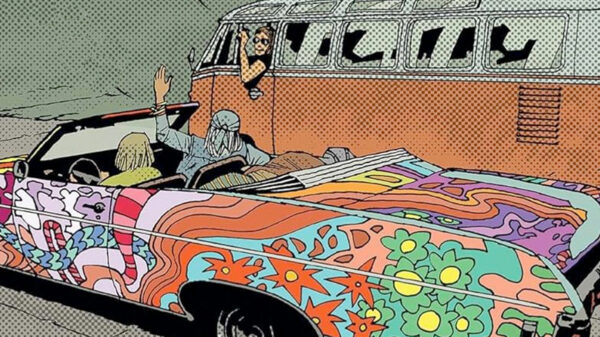
There have been at least thirty-two adaptations of Wuthering Heights for the big and small screens. That’s not a problem in itself: they keep re-upping Hamlet and Scooby Doo, and nobody gets tired of them. A few versions are even amazing. I’m especially fond of R. Sikoryak’s graphic-novel treatment of the novel as a Tales from the Crypt-style E.C. horror comic of the 1950s. It definitely captures the mood. It even reintroduces the narrators.
The trouble starts when you excise everything that made the source work and yet offer nothing new in its place. Cathy likes public hangings? Heathcliff’s into bondage? Fennell could have done anything, but this was the lode she chose to mine.
Emerald Fennell’s movie isn’t just a bad adaptation or teen fanfic. It’s not even porn (well, it’s not good porn). It’s something worse: an excuse to make a movie that grants nothing to its source except its title, and yet which never would have been greenlit without the name of Wuthering Heights. It is a tribute that pays no tribute.
Extras include audio commentary and several featurettes.