

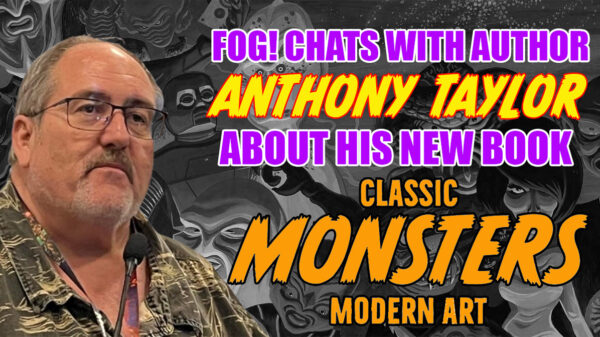






























If you’re a genre fan, there’s a good chance that you either know or have heard of Anthony Taylor. Taylor is a writer and the organizer of Monsterama, an Atlanta retro horror and science fiction convention. His articles have appeared in Famous Monsters of Filmland, Fangoria, Screem, Horror Hound, Retro Fan, SFX, Video WatcH*Dog, FilmFax and many other magazines. His books include The Future Was FAB: The Art of Mike Trim, Arctic Adventure! An Official Thunderbirds™ novel, and The Art of George Wilson.
In June 2024, he was inducted into the Rondo Hattan Classic Horror Awards Monster Kid Hall of Fame.
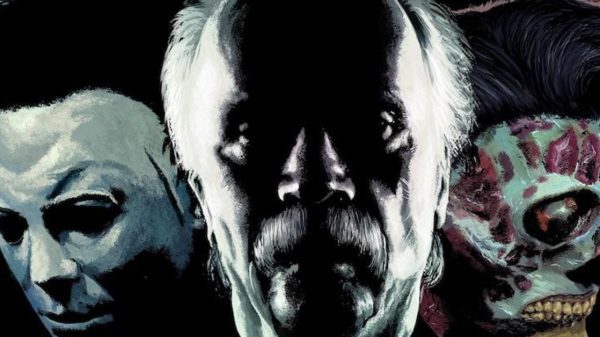
His newest book, Classic Monsters, Modern Art documents and reimagines the trajectory of Gothic horror––from film’s silent era all the way to the turn of the millennium.
Featuring exclusive artwork from more than 45 artists and a richly detailed chronicle from genre expert Taylor, this incredible volume brings together the canonical and the contemporary to create a truly original, timeless experience: a riveting journey through the history of film’s most iconic monsters by way of modern art.
I was fortunate to get a look at this beautiful book and Anthony was generous enough to answer several questions about this release as well as sharing details about his upcoming projects.
* * * * *
FOG!: Congratulations on the release of Classic Monsters, Modern Art! Can you discuss what initiated your love of monsters in general and what was the genesis of this book?
Anthony Taylor: Thanks! I connected with monsters on television and in films pretty early on on a visual basis; they were interesting to look at. I appreciated the thought and effort put into their design on a very basic level.
As I matured and began to feel the growing pains of my teenage years, I (like almost everyone) began to identify with monsters on an emotional level, as I felt like an outsider myself during that period.
I found comfort in watching the Universal monster movies from the ’30’s and ’40’s, as well as the gothic horror from Hammer studios in the ’50’s, ’60’s, and ’70’s.

Art by Doug P’Gosh
I also felt a strong kinship with the poor bastards in just about every episode of The Outer Limits who just wanted to get back home, find a new home, save a planet, stay warm, et al.
In addition to writing, my career path has been as an illustrator, graphic designer, and art director, and I’ve worked with several of the monster properties to design apparel and products over the years. I’ve been a part of the fan community for these films and known and worked with many of the artists who created the most memorable images of some of these iconic characters. I have a degree in Visual Communication with a minor in art history and have long wanted to apply all of this towards a book celebrating the characters that I and so many monster kids think of as friends, and even family to some degree.
In your introduction you defined the book’s parameters to “only include characters and stories created before December 31st, 1999, as represented in art created after January 1st, 2000.” Why did you select these parameters and did it prevent any art that you wanted to include from being in the book?
The why is that it’s a simple hook to let people know that this isn’t a volume reprinting art that they’ve seen since the 1960’s – it’s all from the last 25 years or so. It helped sell the concept to my publisher, Insight Editions, as well; it’s a succinct “log line” for marketing.
The real reason is that I feel like some of the best images of these durable characters have been created since the turn of the century.
There’s a community of artists whose main output is making beautiful pictures of ugly protagonists, and no one had aggregated the work into a single volume before we did in Classic Monsters, Modern Art.

Art by Paul Mann / Art by Graham Humphreys / Art by Paul Mann
At the same time, I wanted to expand on the history of the genre, the history of mass media, the way that we view art and how it affects us and how we affect it. These monsters represent not just our fears but our hopes and dreams; they are a face we not only see in the movies but sometimes in the mirror. Parsing that into a narrative that starts at cave paintings and ends, well... sometime in the future, was a cathartic journey for me, and I’m very happy I took and have shared it.
Your book features work from over forty-five contemporary artists. As each artist presents several pieces of their work, how did you select which artists were the best fit and were there any artists that you wanted to be in the book who weren’t?
The selection process was intensive, to say the least. I wanted to include as many artists as possible whose work was centered around the horror or science fiction genre because these genres move them to create it rather than simply being a nine-to-five job. I already knew quite a few, and found others along the way. I also needed to find a diversity of illustration styles, which I’m happy to say we did.

Art by Dirk Hays; Art by Bob Lizarranga
In addition, we needed to find contributors who looked beyond the most popular characters and created works from lesser known films, books, and television. When we had a bank of assets to choose from, we then needed to match them to the text they would support in each chapter. The images were chosen by myself, my editor, and the art director, and I think we wound up with a bunch of wonderful images created in a variety of media.
There were definitely artists I wanted to include in the book who were invited to contribute but chose not to or were too committed on other work to fit into our timeline. Hopefully this book will be successful enough to warrant a second volume and we can get them into that.
The monsters in the book seem to channel the anxieties of their times—from atomic-age dread to the colder nihilism behind late-century slashers. Were there particular periods where the artwork prompted you to see these creatures in a new thematic light, perhaps revealing meanings you hadn’t considered before?
Always! Within the text, there are many quotes from people I reached out to with questions about how they viewed the subject matter and I incorporated their views profusely.

Art by Jeff Preston
The book is a reflection of the community of media lovers, makers, and commentators as well as the artists themselves and I wanted a variety of viewpoints to be seen. I learned a lot myself from the answers I received, which was the point of writing the book for me—to learn and share.
In an age of CGI and franchise overload, what do you think this kind of lovingly crafted illustration brings back to classic horror that we might be losing on screen?
I don’t think we’re losing much onscreen, I think we’re losing it within ourselves. The information frontier we forged online has become a haven for disinformation with the proliferation of generative A.I., which I abhor. It was developed to create perfect moments for anyone with a keyboard or microphone to prompt a machine that has no limitations imposed on it by conscience. You can’t hold onto and extend perfect moments, and they absolutely, under no circumstances, can be manufactured. Then comes generative A.I.—just tell it what you want and it makes it with no apparent cost to you. But what does it cost us as humans?

Art by Unlovely Frankenstein
It diminishes our souls by making people believe that this is the way of the universe—that perfection can be manufactured at a whim. When that’s the case, it’s no longer perfection, it’s empty victory over an adversary that’s just the loneliness that we feel naturally because we long for something achievable that we have not achieved yet.
It’s natural to feel that loneliness. It drives us to work towards the goals that lay before us. It’s the very nature of humanity, and generative A.I. subverts it by supplying empty calories as nutrients, and the result can only be starvation of the soul.
Anyone can draw. Anyone can write. All it takes is sitting with a pencil and applying oneself long enough. Ideas are worthless. We have known this since the beginning of time; ideas can’t be copyrighted, trademarked, or patented under U.S. laws—only the work that results from the idea.

Art by Doug P’Gosh
Only the application of ideas has any true value, and the only application of ideas that you will ever have domain over are the works you create yourself. Otherwise, it’s just a hollow echo of someone whose work you’ve stolen.
If you take pride in stealing the work of others, you fundamentally misunderstand what it means to be human.
Which four monsters would be included in your own personal Mount Rushmore?
Great question! Surely King Kong and The Creature From the Black Lagoon. Harder to pick the other two, but Frankenstein and H.R. Giger’s Alien are VERY likely candidates.
What are your upcoming projects?
I’m SO busy! April 2nd, my book JACKsploitation! The Films of Jack Hill will be released by Headpress Publishing. I edited and wrote a chapter on his movie The Swinging Cheerleaders for that. August 7-9th in Atlanta will be our 13th Monsterama convention and we’re celebrating 60 years of Dark Shadows and have special event called Mathesontennial: 100 Years of Richard Matheson, paying homage to one of the greatest writers of speculative fiction in history.
I’m also busy editing a Mathesontennial book (for Headpress) that will be out around Halloween. I have a few magazine articles in the works and I’m co-writing a novelization of a 1973 “B-movie” which might get released before the end of the year. The easiest way to keep up with these projects and all my appearances is to have a look at (and bookmark!) my website, GoAnthonyTaylor.com.

Art by Bob Lizarraga
Classic Monsters, Modern Art: 20th Century Horror in 21st Century Illustration
Preface by David Dastmalchian / Forward by Jonathan Maberry
Published by Insight Editions, Is Available Now