























































There are some fantasy, science fiction, and horror films that not every fan has caught. Not every film ever made has been seen by the audience that lives for such fare. Some of these deserve another look, because sometimes not every film should remain obscure.
Sometimes, you can’t begin to imagine how wild a story can get…
The Magic Serpent (1966)
Original Japanese title: Kairyū Daikessen, literally “Great Mystic Dragon Battle”
Distributed by: Toei Studios
Directed by: Tetsuya Yamanochi
All art at its core is built by imagination.
Without imagination, all the elements of a piece of writing on the page make the work read like a police report.
Without imagination, all the elements of a song will just be scale exercises. In film, so much imagination is required up front that without it, the movie never comes into being.
And in some cases, a film will have way more imagination that you could have thought possible…

Just imagine: We open cold on a foggy night in feudal Japan, looking at Ogama Castle in Omi Provence. The film then hits the ground running as we watch as a group of ninjas storm the castle, surprising Lord Ogama (Shinichiro Hayashi) and his wife as they sleep.
His asks for a situation report from the samurai he’s entrusted defense of the castle to, Daijo Yuki (Bin Amatsu). He tells him plainly that the castle has been infiltrated and that there is a traitor who enabled them to get into the castle. Lord Ogama then gets some unpleasant news in a dramatic fashion: The traitor was Yuki, who tells him this right before he draws his katana and kills him.
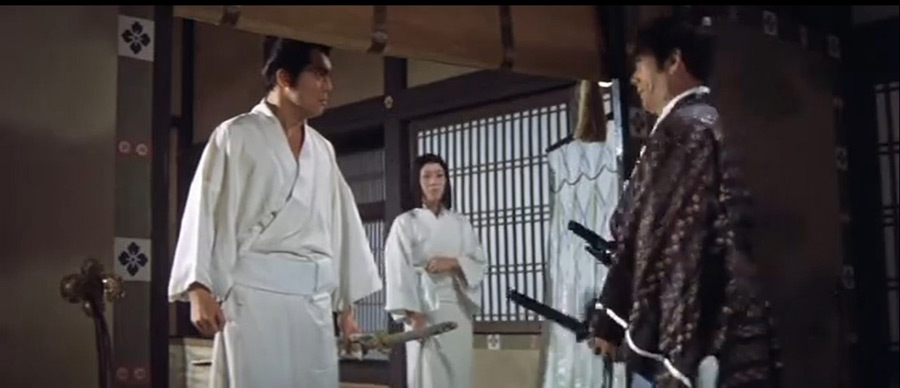
Yuki then gets an update from his aide, Orochimaru (Ryūtarō Ōtomo), who informs him that the castle is secure as the villains stand over the bodies of Lord and Lady Ogama. Just as they think they’ve won, the traitorous two are told that the couple’s son, Ikazuchi-Maru, is fleeing by boat, which Orochimaur says he will handle personally himself.
From there things get wilder, and we haven’t even started the credits, not that that slows things down at all:
When the film resumes picks up the pace again, Ikazuchi-Maru has grown up and is now played by Matsukata Hiroki. He’s spent his time since he fled Ogama Castle under the care of Dojin Hiki (Nobuo Kaneko), learning the ways of the both the ninja and the onmyoji, which becomes useful when ninjas sent by Orochimaru show up:
Immediately after the battle, our hero encounters Tsunade (Tomoko Ogawa), a young woman looking for the father she’s never met, who deserted his family before she was born. Ikazuchi offers to take her to Hiki to see if he could help, but come back to his place too late to save him. Orochimaur came by just before the two showed up and with guile and magic killed his former master.

Hiki gifts Ikazuchi with some final treasures before he dies, and tells him everything about his heritage. The student agrees to avenge his master’s killer, another student, just before Hiroki passes. However, in his last moments, the master sees Tsunade, but is unable to share some information to help her before the end.
Ikazuchi starts his quest alone, and leaves Tsunade to get on with her efforts to track down her oto-san. Before she can do that, she meets an old woman (Hara Sen), who advises her that she should follow Ikazuchi. He also gives her a pin that can summon a spider, and warns her that she can only use the pin once to protect her, for if the spider gets another on-site call it would eat her.

From there, things get wilder. There’s ninjas galore, plots hatched and carried out, betrayals and revelations, and plenty of fight scenes that would put a less ambitious tokusatsu to shame.
And when you think it can’t get more intense, cue the kaiju:
It’s easy to imagine that plot beats this wild could only have come from an eight-year-old hyped up on Pocky. And it’s easy to imagine that some adults were taking more “grown up” treats when it came time to do the film, this being the Sixties and all..
The source material, though, is far older and mainstream than you’d imagine. The film is a loose adaptation of the Jaraiya tales, part of the large body of Japanese folktales. These were hundreds of years old before being collected for print at the beginning of the Meiji Period, during which time William Elliot Griffis would translate a collection of these stories.
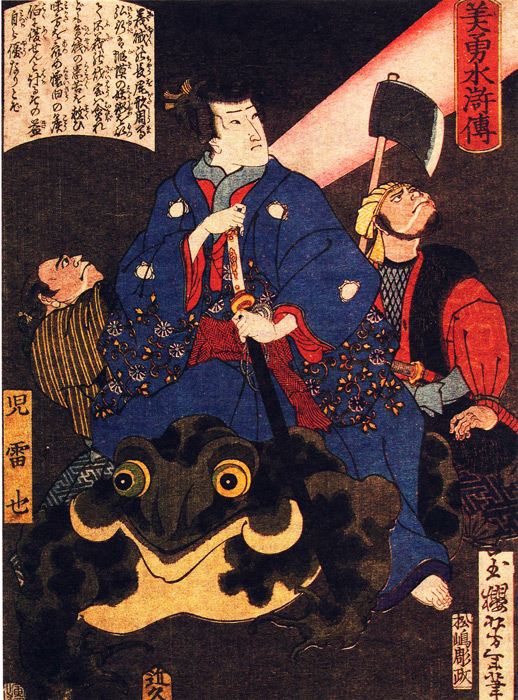
Jaraiya astride a giant toad, as depicted in 1866 by Tsukioka Yoshitoshi
One can’t imagine what the originator of the tales would think if they saw this film. There are plenty of dramatic departures from the known telling, but they fit in surprisingly well with the spirit of the original. The magic, the over-the-top swordfights, and the giant beasts that Masaru Igami put in the screenplay would certainly be accepted by the original audience from the 13th Century as eagerly as the target audience in the 20th Century found them.
And under Yamanochi’s direction, the cast and effects people project such swagger and confidence in what they were doing that the film becomes a fun ride. It’s breezy style generates a sense of fun missing in a lot of films that are unwilling to go as fast and hard as this did. It’s the perfect compromise if half of the room want to watch Kurosawa costume dramas, and the other half just wants Godzilla.

This “aw, you’ll like it, just relax” approach to storytelling would serve Toei well in later years. The mix of swords and sorcery and giant monsters were received positively in Japan, and the studio would take the lessons learned here to their television arm. They’d find considerable success bringing this formula to TV, ultimately producing the series Super Sentai, the program that Saban repurposed in the US as Might Morphin’ Power Rangers.
The film itself, however, did not get as enthusiastic an American reception. American International bought the distribution rights and redubbed everyone (including the kaiju themselves, who ended up with the roars of Godzilla and Rodan coming out of their mouths), but only offered the film in syndication to individual TV stations piecemeal.
Considering what a gem they had, American International in this case showed a severe lack of imagination…



You must be logged in to post a comment Login