
































Classic movie dialogue comee in two flavors: the ones people quote even if they’ve never seen the movie (“You’re gonna need a bigger boat”) and the ones that fans use as a kind of secret password (“He’s a smart big fish, he’s gone under the boat”).
Cameron Crowe’s Jerry Maguire gave us plenty of the first kind—“Show me the money,” “You complete me,” “You had me at hello”—and yet it’s rare to hear anyone repeat those lines today without a healthy salting of irony. Like a boombox-hoisting John Cusack in Say Anything, they plead too hard for our attention.
Crowe’s 2000 follow-up, Almost Famous—it recently celebrated its 25th anniversary as of this writing—has few of the first kind of quote, but many of the other kind, and most of them are still as fresh as the first time we heard them: “It’s not too late for you to become a person of substance, Russell,” “How can you tell? I’m just one of the out of focus guys,” “I’m always home. I’m uncool,” and—this one really depends on knowing the movie—“I’m on drugs.”
 We care about these lines because we care about the people who say them.
All of them are affectionate, largely uncritical portraits (some would say too uncritical) of the almost-famous rock stars that an underaged Cameron Crowe met in his first assignments for Rolling Stone in the early 1970s.
The real bands he covered—The Eagles, Peter Frampton, The Allman Brothers—are melded into the fictional group Stillwater, fronted by enigmatic virtuoso Russell Hammond (Billy Crudup) and thwarted egotist Jeff Bebe (Crowe regular Jason Lee). Penny Lane, who shares her name with the legendary groupie (she prefers “band aid”) who inspired her, is radiantly played by Kate Hudson in her debut role.
Crowe saves his most affectionate and uncritical depiction for his own self-portrait, William Miller.
Played by the tragically underused Patrick Fugit, William is a fifteen year-old babyface who keeps his faith in music even when actual musicians give him absolutely no reason to believe. He stands in not only for Cameron Crowe but for every aging fanboy who still keeps a box of pot-scented LPs in the attic.
Almost Famous is steeped in nostalgia for an all-too-brief season where it seemed like 70s music might actually mean something. The acid-fried hysteria of the hippie era had disintegrated at Altamont; disco was still gestating in Philadelphia loft parties; and the AM band was in the remorseless grip of the Osmonds and the Carpenters.
But FM radio was open territory, the garden where a thousand freak flowers blossomed: southern rock, prog rock, funk, soul; the weird nirvana of Frank Zappa, the glam paradise of David Bowie, even the first stirrings of proto-punk in the persons of Lou Reed, Iggy Pop, and the New York Dolls. Tribes had yet to form: you could easily find James Taylor, Marvin Gaye, and Blue Öyster Cult on the same stack.
This is the world that Almost Famous celebrates. When William’s big sister Anita (a pre-manic pixie dream girl Zooey Deschanel) runs away from home, she leaves him her private record collection and the ambigious promise that “Someday you’ll be cool.” He lights a candle and worships at the altar of Side One of The Who’s Tommy.
Three years later he’s an aspiring rock critic who gets to meet his literary hero, the larger-than-life, died-too-soon Lester Bangs (played with droll anarchy by the larger-than-life, died-too-soon Phillip Seymour Hoffman).

The movie so completely inhabits 1973 that it’s hard to imagine how, just a few years later, that whole world would be swept away by the corporate commercialization of music. “You got here for the death rattle,” Bangs observes while Miller takes precise notes. “Last gasp. Last grope.”
The film celebrates that last gasp in all its fleeting glory: a vision of Penny Lane still dancing to Cat Stevens’s “The Wind” long after the crowd has left; a fourth-wall-breaking joke from the band’s oily new manager (Jimmy Fallon): “If you think Mick Jagger will still be out there trying to be a rock star at age fifty, then you are sadly, sadly mistaken”; and one of the movie’s most beloved set pieces, where a strung-out Russell buries the hatchet with his bandmates by singing along with Elton John.
Even the most diehard rocker, it seems, knows all the lyrics to “Tiny Dancer.”
There’s a different kind of nostalgia at work in Almost Famous: Cameron Crowe’s longing for the movies that inspired him, which he constantly references throughout his own film. William’s first meeting with Penny is a meet-cute worthy of Billy Wilder. The title sequence, where we see William rummaging through ticket stubs and scattered notes, is a swipe from To Kill a Mockingbird. The script’s first line is literally, “I can’t believe you wanna be Atticus Finch. Oh, that makes me feel so good.”
This line is spoken by William’s mother after he (and presumably young Cameron Crowe) made the mistake of telling his mother that he wanted to be a lawyer: almost-famous last words. The phenomenal Frances McDormand plays Elaine Miller, possibly the best overbearing anti-stage mother of modern cinema.
Elaine is not your typical disapproving parent. She encourages William’s rock writing as long as it’s just a hobby. She even signs off on his joining Stillwater on the road, though she reserves the right to tug on that umblical cord.
When Russell tries to charm Elaine, she warns him not to toy with her son’s feelings: “If you break his spirit, harm him in any way, keep him from his chosen profession which is law—something you may not value, but I do—you will meet the voice on the other end of this telephone and it will not be pretty.”

McDormand owns these lines so completely that they are probably related by law in some states.
Billy Crudup’s job in this scene is a lot harder than it might seem. He has to play Russell as cocky but not puncture-proof: he responds to McDormand’s diatribe with a nerveless “Yes Ma’am.” He has to be affable and glamorous, and yet also baldly self-serving, sometimes in the same scene with the same character. In plain words, he makes us believe he’s a rock star.
We see the thousand ways he manipulates William to “make us look cool.” William has no choice but to hang on. He can’t finish his Rolling Stone without an interview with Russell, and Russell knows it. As much as we love Russell Hammond—his rooftop, acid-inspired declaration that “I am a golden god” is a highlight—we see him weaponizing his waywardness.
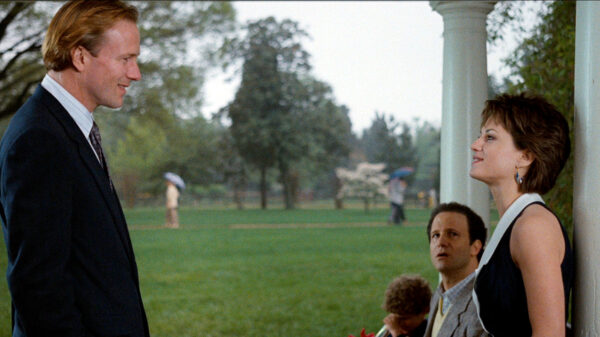
His road romance with Penny is where it stops being a game. The romantic triangle at the heart of the film—William loves Penny but can’t interfere because he needs Russell’s approval—is almost certainly not autobiography, seeing as it’s also the plot of The Apartment.

It’s that little dash of Billy Wilder salt in the wound that keeps Almost Famous from cloying. There are scenes that—well, I was about to say that haven’t aged well, except that they were already cringe in 2000. Russell “trades” Penny to Humble Pie for a case of beer (“What kind of beer?” Penny asks, as if Heineken would be less humiliating than Michelob). Nice-guy William kisses Penny on the mouth while she’s still passed out from trying to overdose on pills. Earlier, young William loses his virginity to a gaggle of groupies. He’s fifteen—and, lest we forget, so is Penny Lane.
All of this is absolutely what Lester Bangs meant when he advised William to be “honest and unmerciful.” It’s possible to love an artist so much that you forgive them even when they’re being awful—remember, this was the era when Jimmy Page abducted a thirteen-year-old girl and made her his mistress—and yet despite this, what shines through is not the debauchery. It’s the music.
This is the connecting thread among our characters on the road—William, Penny, Russell, Lester, all the lost boys and girls who manage to slip past security and mingle with the rock stars. Even when it seems like the “industry of cool” is winning out (Penny says that “famous people are just more interesting”), the music drags our characters back from the brink. Russell falls flat when he tells a crowd of drunken teenagers that his last words are “I dig music”—but it happens to be the truth.
Which is also why Almost Famous still owns a piece of our hearts twenty-five years later, while Jerry Maguire gathers dust in Walmart bargain bins. Music is Cameron Crowe’s muse: he reportedly assembles his soundtracks even before he begins writing a script, and it shows. Every beat of the film is paced to a classic tune, from Simon & Garfunkel’s “America” to Led Zeppelin’s “Tangerine.” The original songs by his partner, Heart’s Nancy Wilson, feel like they emerged shrink-wrapped from the early 70s.
The empire of cool that Lester Bangs warned us about defeated the rebels long ago. Nothing is spontaneous in music today, not even the things they didn’t plan on. The piece that William is writing, the think-piece about a band struggling with its limitations in the harsh face of stardom, would not be assigned today. Who wants to spend weeks baring your soul to some kid journalist when you can accidentally-on-purpose drop your big announcement on your fiancé’s podcast?
This is not to say that music has died… but a certain way of loving music is gone. The kind that led friends to swap records and make mixtapes for their crushes and drop everything to follow a band. The feeling that you’ve discovered a band instead of having it handed to you by an algorithm.
This is the love that Almost Famous embraces: our passion for the almost-famous, the brilliant band that is still trying to rise from the shadows, find its voice, get big without losing the love of its diehard fans.
This is a world that some music fans still hope to revive. And dare I say it, more than a few movie fans as well.




You must be logged in to post a comment Login